Microsoft Copilot in the Philippines: Beginner’s Guide for Businesses
The Philippine workplace is at a crossroads. Hybrid and remote setups have become standard, digital transformation is no longer optional, and employees are being asked to deliver more in less time. Yet, productivity continues to be a challenge. In fact, the 2025 Microsoft Work Trend Index found that almost half of Filipino leaders are pressing for higher productivity, while more than half of employees feel they lack the time and energy to keep up.
For businesses—especially the SMEs that make up 99.5% of the Philippine economy—this imbalance cannot be ignored. Teams are stretched thin, leaders are under pressure to deliver results, and the tools that once supported work now need to actively accelerate it.
This is where Microsoft Copilot comes in. Integrated into the Microsoft 365 apps that many organizations already use every day, Copilot is not about replacing people but about giving them back the most valuable business currency: time.
This beginner’s guide will walk you through what Copilot is, why it matters for Philippine businesses in 2025, and how leaders can adopt it responsibly while addressing challenges like cost, training, and compliance.
Why Time Is the Most Important Currency for Philippine Businesses
Time is the one resource that Philippine businesses cannot expand. Days disappear into reports, meetings, and endless revisions, leaving little energy for strategic priorities. For SMEs, which operate with lean staff, the burden is especially heavy.
- Leaders want more output: 46% of Filipino executives say productivity must increase in 2025.
- Employees are maxed out: 53% admit they lack the capacity to keep up.
- National competitiveness is at stake: McKinsey’s research shows the Philippines must accelerate productivity growth by nearly 60% just to maintain its growth momentum.
This tension is unsustainable. To stay competitive, businesses must find ways to reclaim time—not by asking people to work longer hours, but by helping them work smarter.
Microsoft Copilot: Your Team’s Productivity Multiplier
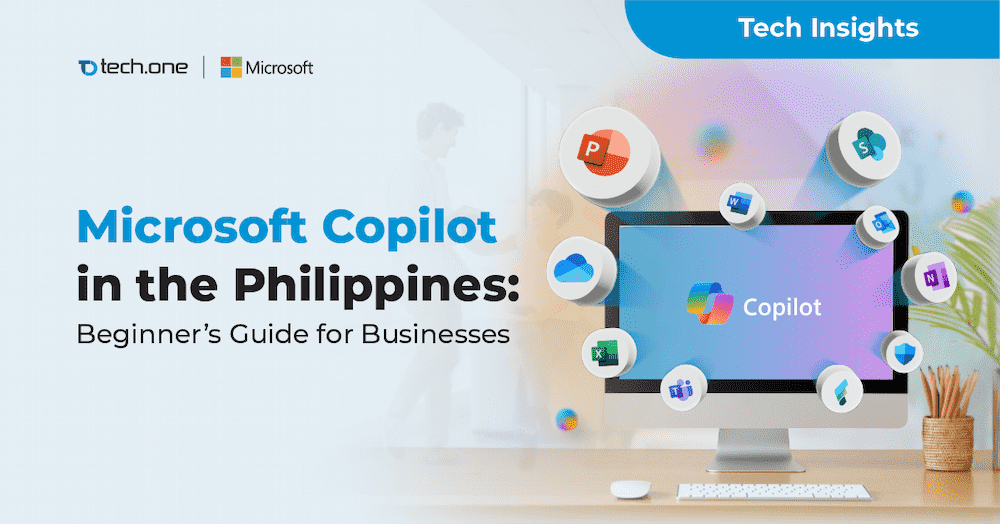
Think of Copilot not as an abstract “assistant,” but as a productivity overlay that helps your people accomplish more using familiar applications. It sits where your people already work:
- Word for drafting, revising, and summarizing long texts.
- Excel for cleaning data, running scenarios, and surfacing trends without complex formulas.
- PowerPoint for turning outlines and briefs into coherent, on-brand decks.
- Teams for capturing discussion highlights, action items, and follow-ups.
What changes is the shape of a typical day. A ten-page client proposal can start from a structured prompt instead of a blank page. Cost-driver questions in Excel can be asked in everyday language. Meetings can be reviewed as decisions and next steps rather than being replayed end-to-end. The point isn’t novelty. It’s shifting time toward thinking and away from rework.
What’s more, with Copilot your data is secured by Microsoft’s comprehensive enterprise-grade security, compliance, and privacy controls. It respects your existing permissions and data boundaries, ensuring that sensitive information stays protected while enabling powerful AI-driven assistance.
Copilot doesn’t create new risks—it works within the frameworks your organization already trusts. Whether you’re drafting a proposal, analyzing financials, or collaborating across departments, Copilot helps you move faster without compromising control.
The result? A workplace where creativity, clarity, and decision-making are amplified—freeing your team to focus on what matters most.
👉 If you want to dive deeper into how Copilot can support collaboration and team workflows in the Philippine setting, read our related article: How Copilot AI Can Support Teams in the Philippines
Why Philippine Organizations Shouldn’t Wait Until “Next Budget Cycle”
2025 is a turning point for the region and the country. Microsoft’s WTI Asia release for the Philippines highlights several signals relevant to boards and executive teams:
Leaders know it’s time to rethink. In the Philippines, 86% of business leaders say 2025 is a pivotal year to re-examine strategy and operations. This mirrors global sentiment but reflects local urgency.
Demand vs capacity is misaligned. Nearly half of leaders say productivity must increase, while 53% of employees say they lack time and energy to perform at their best. That mismatch predicts burnout and stalled initiatives if left unaddressed.
Intelligent agents are moving from idea to plan. 89% of Philippine leaders say they’re confident their organizations will be using AI agents as digital team members within 12 to 18 months. A significant share already report using agents to automate full processes.
Beyond 2025, productivity growth remains a national competitiveness issue. According to a well-known study, the Philippines needs to accelerate its historical productivity growth rate materially to sustain momentum. Tools that reduce process friction are part of that solution space.
Everyday Wins You Can See and Measure
Rather than talking in abstractions, picture the following Philippine-specific scenarios:
- Retail operations
A regional manager used to block half a day to consolidate multi-branch sales, chase down missing files, and prepare weekly slides. With Copilot, raw exports can be stitched together, outliers flagged, and narratives drafted in minutes. The win is not just speed. It’s the ability to act on signals sooner—slow-moving SKUs, shrinkage alerts, or store-level anomalies—before they become month-end surprises.
- BPO/KPO service delivery
Agents who handle high-volume email threads and ticket notes can generate drafts quickly, keep style consistent, and recover context from long chains. Supervisors can review Copilot-generated summaries to spot risks and coach for tone and accuracy. The benefit shows up as faster turnarounds and steadier quality in peak periods.
- Founders and growth teams
Preparing an investor update or product pitch no longer starts with formatting. Copilot helps structure the deck, align visuals, and convert bullet notes into a coherent story. Leaders can focus on the argument, not the slide master.
- SMEs wearing many hats
Owners and general managers often juggle HR, finance, and sales. Copilot can draft policy updates, clean small data sets, and summarize feedback from staff meetings. The business regains hours each week without adding headcount or outsourcing routine tasks.
These are practical, near-term gains that build trust with frontline teams. They also create the internal proof points needed for budget conversations.
How Philippine Leaders Can Kickstart Copilot Adoption
A measured rollout beats a big-bang launch. The most successful PH implementations we see share a few habits:
- Start with eligibility and environment
Confirm that your Microsoft 365 plan supports Copilot and that tenant settings allow access for a pilot group. Your IT team or partner like Tech One Global can enable the buttons in Word, Excel, PowerPoint, and Teams for a limited set of users first. - Pick the right first use cases
Choose low-risk, high-visibility workflows where time savings are easy to verify: weekly business reviews, branch performance summaries, meeting recaps, HR policy refreshes, or client status updates. Keep the scope small enough to learn quickly, but visible enough to matter. - Coach for quality
Provide short, hands-on sessions. Show how to give better prompts, review outputs, and iterate. Identify a few “champions” who will answer questions, collect feedback, and model good habits. - Measure what matters
Track time saved, fewer revision cycles, faster approvals, or improved response SLAs. Microsoft’s 2025 SMB insights note that a majority of SMB leaders expect productivity to increase but also acknowledge they lack time and energy—practical, time-back metrics help close that gap. - Scale gradually
Once you have a few wins, expand to adjacent teams. Use what you learned to refine your playbooks and governance.
Roadblocks to Expect and How to Overcome Them
Every transformation faces resistance, and Microsoft Copilot adoption is no different. In the Philippine business landscape, the most common barriers fall into three categories: cost, trust, and compliance. What separates successful adopters from stalled ones is how leaders anticipate and address these challenges head-on.
Cost and ROI Concerns
For many SMEs, Copilot’s licensing cost can seem high—especially when immediate returns aren’t obvious. The key is to treat adoption like an investment with measurable ROI, not an expense.
How to overcome it:
- Start small but intentional. Pilot Copilot in one or two departments (like finance or HR) where efficiency is easy to measure.
- Track time and output. Measure how much faster reports, presentations, or documents are produced before and after Copilot.
- Document wins. A simple case study showing that one team saved 10 hours per week becomes your internal proof to justify further investment.
When leaders can point to concrete data, budget conversations become easier and more strategic.
Employee Trust and Adoption
Employees may hesitate to rely on Copilot, fearing it could affect accuracy or replace their expertise. The truth is, Copilot works best alongside human judgment, not in place of it.
How to overcome it:
- Position Copilot as a “co-creator,” not a replacement. Communicate that its purpose is to enhance creativity and efficiency, not to take over tasks.
- Invest in training. Short, practical workshops help employees understand what Copilot can and cannot do.
- Build confidence through champions. Early adopters can guide peers and share success stories—this peer influence often carries more weight than formal communication.
When people see colleagues saving time and producing better work, trust grows naturally.
Data Privacy and Compliance
In a country governed by the Philippine Data Privacy Act (RA 10173), protecting personal and business data isn’t optional—it’s a legal requirement. This is often where leaders hesitate the most.
How to overcome it:
- Establish clear policies. Define what types of documents or information Copilot can access and what should remain off-limits.
- Engage your IT Team. Review Copilot’s security features and integration settings to ensure compliance.
- Educate your team. Many privacy risks come from human error. Regular training minimizes accidental exposure of sensitive data. Copilot works within Microsoft’s secure environment, but compliance ultimately depends on internal governance and accountability.
Turning Barriers into Momentum
None of these challenges are deal-breakers. In fact, addressing them properly often strengthens your organization’s digital foundation. The key lies in governance, communication, and patience. By running structured pilots, creating transparent guidelines, and investing in people as much as in technology, businesses can turn hesitation into confidence and ensure that Copilot adoption is both safe and successful.
Leadership Tips for Adoption
Technology by itself does not transform organizations—leadership does. Even the most advanced tools can fall flat if they are introduced without strategy, clear communication, and cultural buy-in. This is especially true in the Philippines, where companies range from lean SMEs to large enterprises with deeply established ways of working. In this context, leaders must take deliberate steps to guide Microsoft Copilot adoption. The goal is to move beyond surface-level trials and instead embed Copilot into workflows in ways that deliver measurable value, foster employee trust, and align with business strategy.
Here are key practices that leaders can apply to make adoption meaningful rather than experimental:
Pilot one department first
Start small but targeted. Functions like finance, operations, or HR deal heavily with repetitive work where efficiency gains can be measured quickly. A focused pilot allows leaders to test outcomes, minimize risk, and gather proof points before scaling.
Define clear metrics and success criteria before rollout
Without defined success measures, adoption risks drifting into “novelty use.” Leaders should establish baselines and measurable outcomes—such as hours saved per person per week, reduced revision cycles, or shorter approval timelines. These metrics build the business case for expansion.
Celebrate internal stories
Success becomes contagious when people hear about their peers achieving it. Sharing examples of unexpected wins—like a finance officer closing monthly reports faster or an HR team reducing policy drafting time—creates momentum and reduces skepticism.
Build a network of “AI Champions”
Early adopters can become internal advocates who guide peers, troubleshoot issues, and collect feedback. This peer-driven support network builds confidence across the organization and accelerates adoption.
Establish rules of usage and guardrails
Copilot must be governed carefully. Leaders need to define what types of data are appropriate, who reviews draft outputs, and how audit cycles are handled. These guardrails not only protect compliance (particularly under the Philippine Data Privacy Act) but also assure employees that usage is structured and secure.
Revisit your deployment periodically
Copilot, like all technology, will continue to evolve. Leaders should schedule regular reviews to assess adoption levels, address gaps, and take advantage of new features. By revisiting deployment, organizations ensure Copilot stays relevant and aligned with business goals.
In short, leadership is what turns Copilot from a software experiment into a strategic asset. When executives set clear goals, establish governance, and nurture a culture of success-sharing, Copilot becomes more than a novelty. It becomes a sustainable productivity engine that helps teams reclaim time, sharpen decision-making, and strengthen competitiveness in a fast-changing Philippine market.
The Future of Work in PH: Will You Lead or Lag Behind?
The stakes are rising for Philippine businesses. According to a 2025 Human Capital Employee Sentiment Study by Aon, 64% of Filipino employees are either already considering a job change or may seek new employment in the next 12 months. This level of turnover readiness underscores a broader shift: workers expect more than just compensation—they want tools, culture, and environments that help them stay motivated and productive.
At the same time, the Philippines’ latest Growth and Jobs Report shows that productivity gains remain limited, with capital accumulation driving most growth rather than efficiency improvements. That gap between potential and performance suggests an economy that still has room to raise its baseline, if businesses can unlock latent capacity.
Against that backdrop, adopting Copilot isn’t optional—it’s a strategic imperative. Leadership cannot merely introduce technology; it must embed it into the way work is done, shape the narrative around it, and measure its effects.
- Leading organizations will shift from “Can Copilot do it?” to “How can we redesign workflows so Copilot helps us scale judgment, not just hours?”
- They will insist on governance, compliance, and transparency so users trust the tool rather than fear it.
- They will focus not just on hours saved, but on how those hours are redeployed—toward client engagement, innovation, or strategic planning.
At Tech One Global Philippines, we help you shape the future of work—not only by implementing technology, but by guiding your strategy, governance, training, and measurement.
As a multi-awarded Microsoft Partner with a Microsoft Solutions Partner designation in Modern Work, 4 Advanced Specializations, and Data & AI expertise, we deliver the trusted guidance organizations need. Our role is to assess your current tools and show how Microsoft 365 can boost collaboration, strengthen security, and drive productivity for your teams today.
👉 Every transformation begins with a conversation. Let’s start yours today.