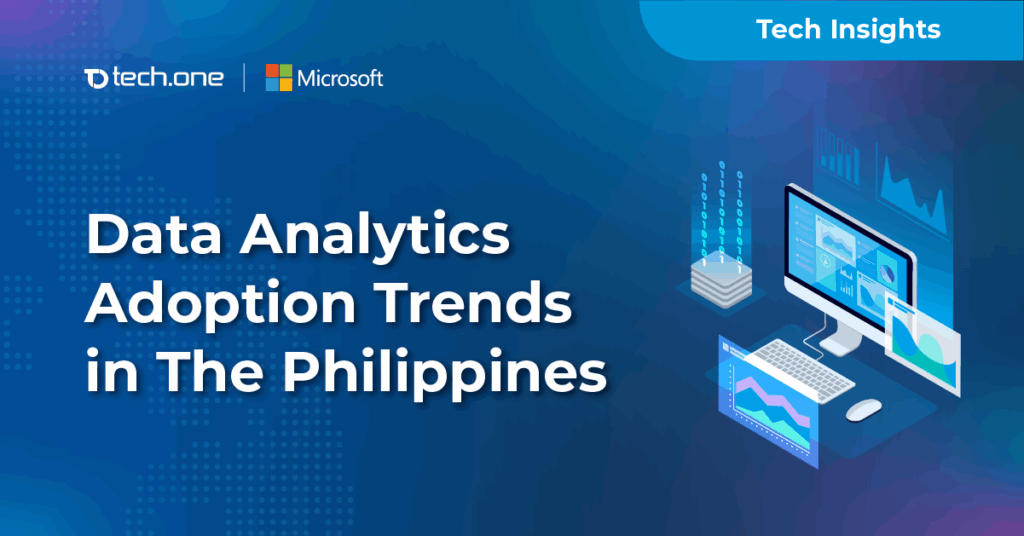
Data Analytics Adoption Trends in the Philippines 2026
As we are nearing 2026, this year has made it clear that data plays a more central role in strategic decision-making than ever before. Operational data, customer intelligence, digital interactions, and regulatory requirements continue to grow, driving the need for stronger analytics capabilities and AI-ready environments. Government digitalization efforts and increasing competition across ASEAN further accelerate the shift toward modern, cloud-enabled analytics platforms.
At the same time, leadership teams are increasingly under pressure to prove the value of their cloud investments. CloudBolt research shows that 78% of IT leaders globally struggle to consistently demonstrate cloud ROI despite reporting confidence in their FinOps maturity.
Locally, studies from the Economist Group highlight that employees in the Philippines prioritize advanced digital skills — particularly Data Analysis/Visualization (55.8%) and AI/ML (42.3%) — yet face systemic barriers such as cost, access, and limited time.
Together, these financial and skills realities are shaping how organizations approach data and analytics adoption through 2026.
This raises a pressing question: How can organizations establish secure, scalable, and AI-ready data foundations that support evolving regulatory, operational, and business demands?
Understanding the key analytics trends shaping the Philippine landscape, along with the challenges organizations continue to face and the cloud capabilities enabling responsible modernization, provides a clearer path forward.
How This 2026 Outlook Was Developed
This outlook is based on global and regional insights from Microsoft, the FinOps Foundation, the Economist Group, ADB, IBM, and Tech One Global Philippines’ hands-on experience delivering Azure-based data modernization projects in the region. The forecast synthesizes cloud ROI challenges, FinOps priorities, AI adoption patterns, and Philippine digital skills data to determine which trends will meaningfully shape analytics adoption through 2026.
Data Analytics Adoption Trends in the Philippines (2026)
According to industry analyses, the following shifts define the Philippine analytics landscape in 2026:
1. Movement Toward Unified, Cloud-Native Data Platforms
Organizations are consolidating disparate systems into unified platforms where data engineering, storage, analytics, and AI operate in a single managed environment. This reduces integration complexity, minimizes tool sprawl, and strengthens data quality across business units.
This aligns with Microsoft and IBM hybrid cloud and data modernization insights, which highlight accelerated consolidation as organizations reduce fragmented data environments.
2. AI-Infused Analytics Takes Center Stage
AI is increasingly embedded in analytics workflows. Predictive modeling, anomaly detection, and generative automation are enhancing operational insights. Platforms where data science and Business Intelligence (BI) share a common foundation enable faster experimentation and more reliable deployment.
Microsoft’s Work Trend Index highlights that organizations are rapidly integrating AI into core business workflows, including analytics-driven decision-making.
3. Regulatory Pressure Elevates Governance and Transparency
Stricter Philippine Data Privacy Act enforcement and expanded oversight across regulated sectors require organizations to maintain clear lineage, controlled access, and transparent data handling. Built-in governance tools are becoming essential for supporting audits and maintaining compliance.
The National Privacy Commission (NPC) continues to emphasize compliance readiness and enforcement, especially for organizations handling regulated data.
4. Hybrid Cloud Becomes the Dominant Architecture
Rather than moving all workloads to the cloud, organizations are adopting hybrid environments, retaining regulated systems on-premise while using cloud services for analytics and AI workloads. This approach supports modernization without disrupting mission-critical operations.
Industry research from IBM and Microsoft confirms hybrid cloud as the dominant architecture for enterprise environments through 2027, particularly within regulated sectors.
5. Real-Time and Streaming Analytics Gain Momentum
Industries such as logistics, retail, and fintech increasingly rely on real-time insights. High-throughput streaming pipelines support real-time monitoring, anomaly detection, and instant analysis, moving organizations beyond batch-driven reporting.
Microsoft reports rising adoption of real-time streaming services like Azure Event Hubs across Asia as organizations shift from batch to event-driven systems.
6. FinOps Becoming a Strategic Requirement
As analytics workloads grow, cloud consumption management becomes a strategic priority. Platforms with granular usage insights, forecasting, and rightsizing recommendations help organizations maintain financial control and operational efficiency.
The FinOps Foundation highlights that optimization and waste reduction remain top priorities for practitioners worldwide.
7. Partner Ecosystems Becoming Essential Due to Skills Gaps
The shortage of skilled data engineers, cloud architects, and governance specialists continues to affect analytics maturity. Many organizations depend on technology partners for architecture design, cloud deployment, and capability building.
Reports from Deloitte and broader regional studies highlight persistent cloud and analytics talent shortages across ASEAN.
8. AI-Ready Data Foundations Become a Board Priority
Leadership teams increasingly emphasize AI readiness. Trustworthy pipelines, high-quality data, and secure model governance are becoming essential requirements. Cloud-native ecosystems support both traditional analytics and emerging AI workloads within a unified governance framework.
While these trends show strong forward momentum, many Filipino organizations are still unable to fully capitalize on them. As adoption accelerates, the real gap is no longer awareness — it is execution. Fragmented systems, limited analytics talent, and governance bottlenecks continue to slow progress and dilute business impact.
Based on Tech One Global’s experience supporting Philippine enterprises, the organizations advancing fastest are those standardizing on modern cloud analytics platforms that unify data, strengthen controls, and enable AI at scale. This sets the stage for the next step: understanding the operational challenges that must be addressed for these trends to translate into measurable results.
Key Challenges Filipino Organizations Face — and How Modern Cloud Analytics Platforms Address Them
- Disconnected Systems Limiting Enterprise-Wide Visibility
Many organizations still rely on a mix of legacy applications and isolated databases that were never designed to work together. This fragmentation makes it difficult to build accurate, organization-wide insights and leads to inconsistent or duplicated reporting.
How a Modern Analytics Environment Fixes This: Cloud-native platforms unify ingestion, transformation, storage, and reporting, creating a single, reliable dataset for the entire organization and reducing the need for duplicated pipelines.
- Infrastructure Barriers That Prevent Scaling Analytics Capabilities
As data volumes grow, traditional on-premise infrastructure often becomes a bottleneck. Hardware constraints, rising maintenance costs, and slow upgrade cycles limit an organization’s ability to process complex or large-scale workloads.
How Cloud-Native Infrastructure Overcomes the Limitation: Elastic compute and adaptable storage allow organizations to scale resources as required, ensuring performance during peak workloads without major capital investment.
- Heightened Governance and Compliance Requirements Increasing Operational Risk
Stricter expectations around data handling, especially those related to the Philippine Data Privacy Act and sector-specific regulations, require organizations to maintain full transparency and control over how data is accessed, stored, and shared. Managing this across scattered systems significantly raises operational risk.
How Built-In Governance Addresses the Risk: Embedded governance features, such as lineage tracking, access controls, encryption, and retention policies, help organizations meet compliance standards while reducing manual monitoring.
- Limited Analytics and Cloud Expertise Slowing Adoption Efforts
Even as interest in analytics grows, many organizations face shortages in data engineering, cloud architecture, and governance talent. This slows modernization, increases project dependencies, and restricts the ability to innovate at speed.
How Intelligent Analytics Tools Reduce Skill Dependencies: Guided workflows, automation, low-code capabilities, and pre-built connectors simplify the development and maintenance of analytics pipelines. Technology partners such as Tech One Global Philippines offer implementation support, training, and ongoing operational assistance.
- Operational Overhead from Managing Fragmented Toolchains
When organizations rely on separate tools for data integration, warehousing, BI, and AI, operational overhead quickly escalates. Each system has its own configuration, governance model, and maintenance schedule, creating inconsistencies and slowing delivery.
How an Integrated Platform Eliminates Tool Fragmentation: Unified analytics ecosystems consolidate core workloads, reducing tool sprawl, improving data consistency, and speeding up insight delivery.
Across these challenges, a consistent pattern emerges: the barriers slowing analytics adoption are systemic — fragmented data estates, limited skills, and rising governance demands. Solving them requires more than individual tools; it requires a modern cloud analytics foundation that unifies data, operations, and governance in a single environment. For many organizations in the Philippines, this is why cloud-native platforms such as Microsoft Azure are becoming the strategic backbone for achieving reliable, scalable, and AI-ready analytics outcomes.
Why Cloud Platforms Like Microsoft Azure Are Emerging as Strategic Foundations
Modern analytics requires environments that are secure, scalable, and prepared for AI-driven workloads. Drawing from years of delivering Microsoft-based data modernization projects in the Philippines, Tech One Global experts recognize Microsoft Azure as a platform that strongly aligns with the analytics and AI priorities of local organizations.
- Governance-First Architecture for Regulated Data
Azure provides built-in governance controls such as classification, lineage visibility, encryption, and centralized identity management, to help organizations manage sensitive information with confidence and maintain compliance with the Philippine Data Privacy Act requirements.
- Unified Analytics and AI Ecosystem
Azure brings data engineering, warehousing, business intelligence, and machine learning together within a single ecosystem. This reduces integration challenges, strengthens data consistency, and enables teams to move from ingestion to insight more efficiently.
- Enterprise-Scale Performance for Expanding Workloads
Azure adjusts easily to expanding datasets, increased user demand, and more advanced analytical needs. This adaptability allows organizations to scale their analytics capabilities without major infrastructure changes.
- Hybrid-Ready Capabilities to Support Local Needs
Azure supports seamless integration between on-premise systems and cloud-based analytics environments. This is especially valuable for organizations with regulated workloads or those operating in locations with inconsistent connectivity.
- FinOps-Aligned Cost Governance
Azure provides tools for analyzing usage patterns, forecasting costs, optimizing resource allocation, and identifying anomalies. This level of transparency helps organizations manage spending responsibly while maintaining performance and reliability.
- A Secure and Scalable Foundation for AI and Advanced Workloads
Azure supports the full AI lifecycle, from data preparation to model deployment and monitoring, within a governed environment. This enables organizations to adopt AI responsibly and scale advanced workloads with structured oversight
Together, these capabilities position Azure as a strategic foundation for organizations aiming to strengthen their analytics maturity and prepare for responsible, scalable AI adoption.
Conclusion
Organizations in the Philippines are steadily moving toward unified, governed, and AI-ready analytics ecosystems. Cloud-native platforms provide the scalability, flexibility, and governance needed to support real-time insights, long-term transformation initiatives, and responsible AI adoption.
Tech One Global Philippines supports this shift by helping organizations build analytics environments that are secure, efficient, and aligned with business goals. We have Microsoft Solutions Partner Designations in Azure (Infrastructure), Azure (Digital & App Innovation), and Azure (Data & AI) with Advanced Specializations in Infra and Database Migration and Migrate Enterprise Applications to Microsoft Azure; we bring both global expertise and local insight to every engagement.
Our cloud services practice is grounded in real delivery experience across Azure infrastructure, data, and security. Our architects and engineers bring deep certifications and hands-on expertise from mission-critical deployments across the region. With a strong focus on governance, cost control, and ongoing optimization, we help organizations adopt Azure with confidence, ensuring environments remain secure, scalable, and aligned with business outcomes.
Structured Assessments to Guide Your Cloud and AI Strategy
🗹 Azure Migrate & Modernize: Infrastructure and Database Migration
Evaluate your cloud maturity, architectural gaps, and modernization priorities through structured assessments tailored to your current environment.
Assess your infrastructure, workloads, and dependencies to develop a clear, secure, and aligned roadmap for migrating to Azure.
🗹 Migration Readiness Assessment
Prepare your applications, databases, and workloads for cloud migration using structured methodologies and Microsoft-aligned best practices.
Determine your organization’s AI maturity, data readiness, and governance posture to enable responsible and scalable AI adoption.