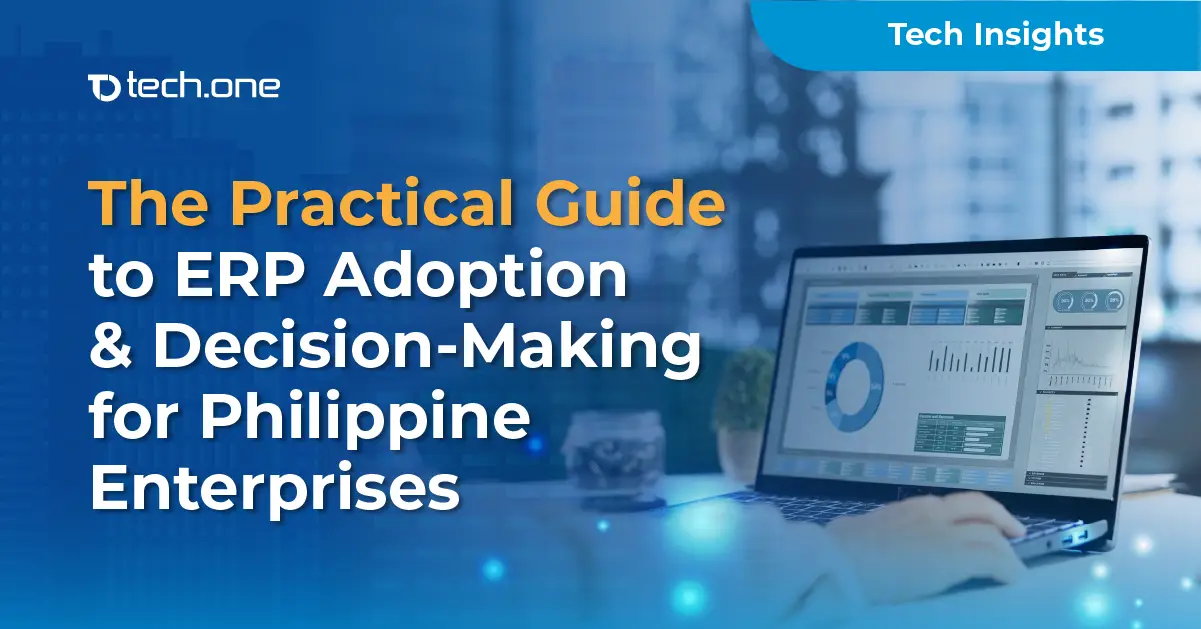
The Practical Guide to ERP Adoption & Decision-Making for Philippine Enterprises
Enterprise Resource Planning (ERP) has become a core component of how modern organizations operate, govern, and scale. For many enterprises, these platforms underpin financial control, operational visibility, and the credibility of management reporting. As a result, decisions about core enterprise systems are no longer confined to IT; they now sit at the intersection of finance, operations, and executive governance.
This guide is intended for enterprise leaders evaluating their current systems in the context of growth, complexity, and increased accountability. Whether an organization is operating on legacy accounting platforms, an aging enterprise system, or a patchwork of disconnected tools, the underlying question is increasingly the same: are current systems still fit for the organization’s scale and risk profile?
For Philippine enterprises, this question carries additional weight. Expansion across entities, tighter reporting expectations, audit readiness, and regulatory requirements such as BIR Computerized Accounting System (CAS) compliance and the Ease of Paying Taxes (EoPT) law place greater demands on foundational platforms. At the same time, the cost and disruption of change remain significant, making these decisions both strategically important and risk-sensitive.
ERP discussions in 2026 therefore look materially different from those of the past. They are driven less by functionality gaps and more by concerns around governance, data integrity, scalability, and long-term operating resilience.
This guide provides a strategic, non-technical overview to help enterprise decision-makers frame the issue correctly. It does not cover product features or implementation steps. Instead, it outlines why ERP matters now, what modern platforms are designed to enable, and which considerations should shape decisions before any solution or project is defined.
Understanding why ERP has become business-critical is the starting point. The next step is to examine the business realities pushing Philippine enterprises to re-evaluate their ERP landscape today.
ERP in Today’s Business Context
Why Philippine Enterprises Are Re-Evaluating ERP Now
When enterprises reassess whether their ERP system is still the right fit, the trigger is rarely internal preference. More often, the pressure comes from outside the organization — from markets, regulators, customers, partners, and technology shifts that raise expectations faster than legacy systems can keep up.
For Philippine enterprises, these external forces are converging. What once felt like manageable inefficiencies now surface as competitive gaps, compliance exposure, operational friction, and growth constraints, pushing ERP from a background system to a leadership-level concern.
Below are the most common external pressures driving ERP re-evaluation today, and what they look like in real business terms.
Key External Forces Driving ERP Reassessment
1. Market and Competitive Pressure Is Raising the Bar for Speed, Insight, and Operational Responsiveness
As competitors adopt cloud-native, real-time enterprise platforms, the pace of business continues to accelerate.
External pressure: Markets increasingly reward organizations that can make faster decisions, respond quickly to demand changes, and act on accurate, up-to-date information across finance and operations.
What this looks like in real life: Leadership sees competitors closing books faster, adjusting pricing sooner, or responding to supply-chain disruptions in days, while internal reporting cycles still take weeks. Over time, ERP begins to affect competitive positioning, not just internal efficiency.
Typical trigger: “Our competitors can react in days. We need weeks.”
2. Technology Evolution Is Outpacing What Legacy ERP Architectures Can Support
The enterprise technology landscape has shifted toward connected, cloud-based ecosystems.
External pressure: Cloud platforms, automation, embedded analytics, and API-driven integrations are becoming standard expectations. Many legacy ERP environments struggle to connect with modern tools.
What this looks like in real life: ERP systems cannot easily integrate with e-commerce platforms, advanced planning tools, or data and analytics initiatives. As a result, broader technology roadmaps slow down or stall because the core system cannot support them.
Typical trigger: “Our ERP can’t support the technology roadmap.”
3. Regulatory and Compliance Change Is Shifting Accountability from Process to System
Regulatory expectations continue to evolve, particularly around digital reporting, traceability, and audit readiness.
External pressure: Tax digitization, stricter reporting standards, and data governance requirements increasingly expect systems to produce accurate, auditable information by design, rather than relying on manual fixes.
What this looks like in real life: Compliance depends on spreadsheets outside the ERP. Manual workarounds extend audit cycles, increase risk, and raise the cost of compliance as reporting requirements become more complex.
Typical trigger: “Compliance now depends on spreadsheets outside the system.”
4. Customer Expectations Are Turning ERP from a Back-Office System into a Front-Line Enabler
Customer expectations for speed, accuracy, and transparency continue to rise across industries.
External pressure: Markets increasingly expect real-time inventory visibility, reliable delivery commitments, and seamless experiences across physical and digital channels.
What this looks like in real life: ERP limitations prevent accurate delivery promises or integrated order visibility. Over time, system constraints begin to affect customer satisfaction, service levels, and brand credibility.
Typical trigger: “Our ERP is starting to hurt customer experience.”
5. Supplier and Partner Ecosystems Are Forcing ERP Integration and Automation Readiness
Supply chains and partner networks are becoming more digitally interconnected.
External pressure: Suppliers, logistics providers, and business partners increasingly expect electronic invoicing, real-time data exchange, and automated procurement and fulfillment processes.
What this looks like in real life: Partners mandate digital integration standards that legacy ERP systems cannot support without extensive customization, slowing collaboration and increasing operational friction.
Typical trigger: “Our partners are more digital than we are.”
6. Mergers & Acquisitions (M&A), Expansion, and New Business Models Are Stress-Testing ERP Scalability and Structure
Growth events often expose structural limits in core enterprise systems.
External pressure: Acquisitions, regional expansion, and new revenue models introduce complexity across entities, currencies, tax regimes, and reporting structures.
What this looks like in real life: Legacy ERP systems struggle to support multi-entity consolidation, cross-border reporting, or rapid organizational change without heavy manual intervention.
Typical trigger: “Our ERP can’t scale with how we’re growing.”
7. Talent and Workforce Market Dynamics Are Increasing the Cost and Risk of Legacy ERP Skills
Labor market dynamics are reshaping expectations around enterprise systems.
External pressure: Modern talent expects intuitive, modern tools, while skills for older ERP platforms are becoming scarcer and more expensive to maintain.
What this looks like in real life: Organizations become dependent on a shrinking pool of specialists, increasing operational risk, slowing innovation, and raising long-term support costs.
Typical trigger: “We can’t hire people who want to work on this system.”
8. Vendor and Support Dynamics Are Compressing ERP Decision Timelines
ERP vendors themselves are reshaping the enterprise software landscape.
External pressure: End-of-life announcements, forced upgrade paths, rising maintenance costs, and reduced innovation on legacy platforms shorten the window for decision-making.
What this looks like in real life: Leadership faces increasing support costs with diminishing returns, while meaningful innovation shifts to newer architectures that legacy systems cannot access.
Typical trigger: “Vendor support is ending or getting too expensive.”
Individually, each of these pressures can strain existing systems. When they occur together, they fundamentally change how leaders view ERP.
Instead of being treated as a system to maintain, ERP increasingly becomes a platform that determines how effectively an organization can respond to external demands, manage risk, and scale with confidence.
This shift leads naturally to the next question: “What modern ERP systems are actually designed to enable — and how today’s platforms differ from the systems many organizations are still running?”
What Modern ERP Systems Are Designed to Enable
Modern ERP systems are best understood not as collections of features, but as platforms that enable enterprise-wide capabilities. Their primary purpose is to unify data, processes, and governance across the organization so leaders can operate the business as a single, coherent system rather than a patchwork of disconnected functions.
At a strategic level, ERP provides a single source of truth for core operational and financial data. This shared foundation ensures consistency in reporting, accountability in execution, and transparency across departments such as finance, supply chain, HR, manufacturing, and sales. Decisions are no longer based on fragmented spreadsheets or conflicting system outputs, but on reliable, real-time information.
From an operational perspective, modern ERP systems are designed to standardize and automate processes while remaining flexible enough to adapt to change. They embed best practices, enforce controls, and reduce manual handoffs, allowing organizations to operate efficiently at scale without sacrificing compliance or accuracy. This is especially critical in regulated or high-growth environments where complexity increases faster than headcount.
For leadership, the true value of ERP lies in visibility and control. Executives gain end-to-end insight into performance, risks, and constraints—across regions, business units, and time horizons. This visibility enables proactive management rather than reactive firefighting, supporting faster course correction and more confident strategic bets.
Finally, modern ERP systems are designed to scale with the business. Whether through cloud architectures, modular deployments, or integration with advanced analytics and automation, ERP provides a durable backbone that can absorb growth, acquisitions, regulatory change, and new business models without requiring constant reinvention.
In short, modern ERP enables organizations to see clearly, operate coherently, and scale deliberately—turning operational complexity from a liability into a managed, strategic asset.
What Makes ERP “Modern” in 2026
Many organizations already run an ERP or accounting system, yet still struggle with fragmented data, slow decision cycles, and inflexible operations. What distinguishes modern ERP platforms in 2026 is not incremental feature improvement, but a fundamental shift in how ERP supports growth, governance, and leadership decision-making.
Modern ERP is defined by a small set of structural characteristics that directly enable business outcomes rather than merely automate transactions.
- Cloud-native architecture is foundational. Unlike legacy systems retrofitted for hosting environments, modern ERP platforms are designed from the ground up to operate in the cloud. This enables elastic scaling, faster deployment of regulatory and functional updates, and global expansion without the capital expense, upgrade cycles, or infrastructure rigidity of on-premise systems. The organization gains agility without trading off stability.
- Real-time visibility replaces periodic reporting as the operating norm. Modern ERP systems surface financial and operational data as activity occurs, allowing leaders to understand performance, cash position, and risk continuously rather than retrospectively. This shift supports faster decisions, earlier intervention, and tighter alignment between strategy and execution.
- Configurability over heavy customization marks a critical architectural evolution. Legacy ERP often required deep code-level customization to reflect business processes, creating technical debt and upgrade risk. Modern ERP platforms emphasize configuration—rules, workflows, approvals, and reporting structures that can be adjusted as the business evolves. This allows organizations to change how they operate without rebuilding the system each time the operating model shifts.
- Embedded controls and governance move compliance from a periodic exercise to a built-in operating capability. Modern ERP systems integrate access control, segregation of duties, audit trails, and policy enforcement directly into daily workflows. This reduces reliance on manual oversight and after-the-fact reconciliation, strengthening internal control while lowering compliance cost and risk.
Taken together, these characteristics represent a shift from ERP as static back-office software to ERP as an adaptive enterprise platform. Modern ERP does not merely record what has happened; it enables organizations to operate with clarity, control, and confidence as conditions change—without repeated system overhauls or structural resets.
In 2026, “modern” ERP is ultimately defined by its ability to absorb change while preserving trust in the numbers and discipline in execution.
Why Finance Transformation Often Leads to ERP Adoption
In many enterprises, the pressure to modernize is often first felt in finance. Month-end delays, inconsistent data, and audit pressure tend to appear earliest in finance teams, turning operational friction into a leadership issue rather than a back-office inconvenience.
| Finance Reality at Enterprise Scale | What ERP Is Designed to Enable |
|---|---|
|
Manual reconciliation across multiple systems |
Faster, more predictable close cycles through a consolidated financial view |
|
Forecasts built on delayed or inconsistent data |
Greater confidence in planning using enterprise-wide information |
|
Audit preparation is handled after the fact |
Continuous audit readiness through built-in controls |
|
Time spent validating data |
Greater focus on analysis and decision support |
|
Central accountability for regulatory reporting |
Institutionalized controls that scale across the organization |
As regulatory expectations rise and organizations grow in complexity, finance leaders carry accountability for data integrity and reporting credibility. ERP provides a way to embed these disciplines at an enterprise level rather than relying on manual controls and individual expertise.
While the platform supports many functions, finance often acts as the catalyst, positioning ERP as a foundation for control, insight, and long-term resilience.
ERP as a Unified Financial and Operational Platform
At its core, ERP unifies an organization’s financial and operational activities on a single platform with a shared data foundation. Instead of running separate systems by function, this model aligns critical areas around one consistent view of the business.
At an enterprise level, this typically enables:
- Finance and accounting – consolidated visibility across entities, faster consolidation, and more consistent management reporting
- Procurement and spend management – centralized oversight of purchasing activity, commitments, and supplier spend
- Inventory and supply operations – aligned inventory, cost, and fulfillment data across locations and business units
- Project and cost tracking – integrated visibility into budgets, actuals, and performance within the same financial framework
What differentiates this model is not the individual functions themselves, but the fact that they operate on the same underlying data. This reduces duplication, minimizes reconciliation effort, and allows leadership to manage the organization as a single enterprise.
For organizations with multiple branches or subsidiaries, this unified approach supports consolidated reporting, reduces reliance on spreadsheets and manual workarounds, and improves consistency across the business.
In practice, this is how platforms such as Oracle NetSuite or Microsoft Dynamics 365 Business Central are positioned at an enterprise level, not as departmental tools, but as systems that allow finance and operations to run in sync.
Understanding what modern ERP systems are designed to enable is only part of the decision. The next consideration is how ERP initiatives succeed, or fail, in practice.
ERP Implementation & Migration: Strategic Realities Leaders Must Prepare For
Implementing or migrating an ERP system is not a routine IT upgrade. It is a high-impact business transformation that reshapes how finance, operations, and leadership teams work together. The system becomes the foundation for how the organization executes strategy, governs risk, and measures performance.
For Philippine enterprises, ERP initiatives often coincide with growth, regulatory change, and increasing operational complexity. These conditions heighten both the value and the risk of ERP transformation, making executive ownership and clear expectations essential.
Leaders must prepare for several strategic realities:
- Outcomes are driven more by governance than technology. ERP success depends less on the system selected and more on how leadership defines accountability, decision rights, and data ownership from the outset.
- ERP forces operating model decisions. Standardization, controls, and transparency require leaders to actively decide where the organization will operate uniformly and where flexibility is justified—and to sponsor those choices through resistance.
- Change management is a leadership responsibility. ERP changes how people work every day. Without visible executive sponsorship and reinforcement, users will default to workarounds that undermine system integrity.
- Go-live is the beginning, not the end. Long-term value depends on post–go-live governance, process ownership, and continuous refinement, not the implementation milestone itself.
In practice, ERP implementation succeeds when leaders treat it as an enterprise design decision rather than a software project—using the system to strengthen discipline, transparency, and scalability across the organization.
ERP Is a Business Transformation Program, Not an IT Project
Once ERP is recognized as a business transformation, the critical question shifts from who implements the system to how the enterprise is led through change. ERP programs fail not because of weak technology, but because leadership behaviors, incentives, and decision structures are misaligned with the scale of change being introduced.
At the leadership level, effective ERP programs require a different operating posture:
- Explicit trade-off ownership, where senior leaders actively resolve tensions between speed, control, cost, and local autonomy rather than delegating those decisions to the project team.
- End-to-end process stewardship, with accountable owners for cross-functional processes (e.g., order-to-cash, procure-to-pay, record-to-report) instead of siloed functional optimization.
- Time-bound decision governance, ensuring that design and policy decisions are made quickly, escalated appropriately, and documented—preventing design drift and implementation paralysis.
- Behavioral reinforcement, aligning performance metrics, incentives, and management routines with the new processes and controls embedded in the ERP system.
Organizations that apply this leadership discipline use ERP as a mechanism to clarify how the business operates and how decisions are made. Those that do not often experience slow implementations, diluted benefits, and post–go-live regression to legacy behaviors.
This distinction explains why ERP outcomes diverge sharply across organizations using similar platforms—the difference is not the system, but the leadership model applied to it.
Where ERP Programs Commonly Break Down
Even with strong intent and sponsorship, ERP initiatives can falter when critical risks are underestimated or misunderstood. Most failures do not stem from a single flaw, but from a small set of predictable breakdown points that compound over time if left unaddressed.
- Misaligned scope and expectations
ERP programs often attempt to solve too many problems at once—process redesign, reporting transformation, regulatory compliance, and organizational change—without matching ambition to organizational capacity. When scope is not sequenced or clearly prioritized, timelines slip, teams burn out, and leadership confidence erodes.
- Weak change leadership
ERP success depends on adoption, not configuration. When leaders delegate change ownership to project teams or underinvest in sponsorship, training, and reinforcement, users default to legacy processes and shadow systems. This results in technically “live” systems that are operationally underutilized and strategically ineffective.
- Underestimated data complexity
Data is frequently treated as a technical migration task rather than a business discipline. Poor master data quality, unclear data ownership, and unresolved historical inconsistencies undermine trust in the system’s outputs. Once credibility is lost, decision-makers revert to offline reports, negating the core value of ERP.
Beyond leadership and governance, starting conditions matter. Migration effort is rarely uniform across organizations or business units. Legacy customizations, fragmented data models, and informal workarounds significantly affect complexity and risk. Assumptions that ERP implementations can be accelerated through simplification alone often prove misleading.
Organizations that anticipate these breakdown points early—by calibrating scope, actively leading change, and treating data as a strategic asset—are far better positioned to sustain momentum and realize ERP’s intended business value.
Migration Complexity Depends on Your Starting Point
ERP migration effort is shaped far less by the platform selected than by the organization’s current operating and data environment. Two companies adopting the same ERP can experience dramatically different timelines, costs, and risk profiles based solely on where they are starting from.
Several factors materially influence migration complexity:
- Legacy accounting tools versus legacy ERP systems
Organizations moving from basic accounting software often face simpler technical migration but greater process maturity gaps. Conversely, companies migrating from heavily customized legacy ERPs must unwind years of embedded workarounds, bespoke logic, and undocumented dependencies—often making the transition more complex despite greater system sophistication.
- Data structure and quality
ERP migration exposes underlying data issues that may have been masked by manual reconciliations or offline reporting. Inconsistent master data, unclear ownership, and poor historical integrity increase both migration effort and post–go-live risk. Data readiness is frequently the critical path, not system configuration.
- Entity and reporting complexity
The number of legal entities, currencies, tax regimes, and reporting requirements significantly affects design and testing effort. Organizations operating across multiple jurisdictions or business models must resolve reporting and consolidation logic upfront rather than retrofitting it after go-live.
These realities explain why ERP timelines cannot be standardized or compressed based on vendor benchmarks alone. Simplification assumptions—such as “we’ll clean data later” or “we’ll standardize after go-live”—often shift risk rather than reduce it.
For many enterprises, the next challenge is no longer understanding what ERP should enable, but determining how to move forward with clarity, confidence, and minimal disruption. That typically requires deliberate sequencing, strong governance, and leadership oversight—often supported by a strategic technology partner who understands both enterprise operating models and local regulatory and operational realities in the Philippines.
In practice, successful ERP migration begins with an honest assessment of the starting point, not optimism about the destination.
Why Enterprises Work with Tech One Philippines
When ERP decisions carry financial, operational, and regulatory implications, enterprises tend to look for partners with both delivery depth and local context.
Tech One Philippines supports organizations modernizing ERP environments in ways that align with business objectives, regulatory requirements, and long-term operating models. With over two decades of regional experience, the firm works across industries where ERP decisions are closely tied to governance, scale, and execution risk.
Rather than approaching ERP as a technology rollout, Tech One Global engages at the intersection of finance, operations, and IT, helping organizations frame ERP decisions within broader enterprise priorities.
Enterprises work with Tech One Philippines for a combination of factors:
- Breadth across leading ERP platforms
Experience delivering ERP initiatives on Oracle NetSuite and Microsoft Dynamics 365 Business Central, supporting different enterprise operating models and growth paths.
- Certified ERP Delivery Team
A certified, cross-functional delivery team with deep experience across finance, supply chain, manufacturing, and services ensures ERP systems are designed and executed around how the business actually operates.
- Familiarity with Philippine regulatory expectations
Experience supporting BIR Computerized Accounting System (CAS) readiness and Ease of Paying Taxes (EOPT) compliance, reducing uncertainty around audit and reporting obligations.
- Continuity across the ERP lifecycle
Support spanning strategy, migration, implementation, and ongoing operations, enabling organizations to evolve systems without repeated resets.
- Local delivery with regional understanding
Philippine-based teams bring familiarity with local workflows, regulatory nuance, and enterprise change dynamics.
This combination allows ERP modernization to proceed with greater alignment, clearer governance, and fewer surprises as organizations scale.
For many leaders, the next step is not choosing a system, but gaining an objective view of readiness, risk, and priorities before moving forward.
Book a Free ERP Modernization Consult!
ERP decisions shape how organizations operate for years. Before committing budget or timelines, many enterprise leaders choose to validate assumptions and clarify risks.
A strategy consultation can help you:
- Assess whether current systems remain fit for scale
- Identify potential constraints or risks early
- Clarify priorities before engaging in selection or implementation