AI Adoption in the Philippines Needs Security by Design: Why the Best AI Initiatives Start with Security, Not Technology
Walk into almost any boardroom in the Philippines right now and AI is on the agenda. The enthusiasm is earned — the productivity gains, faster decisions, and sharper customer experiences are real.
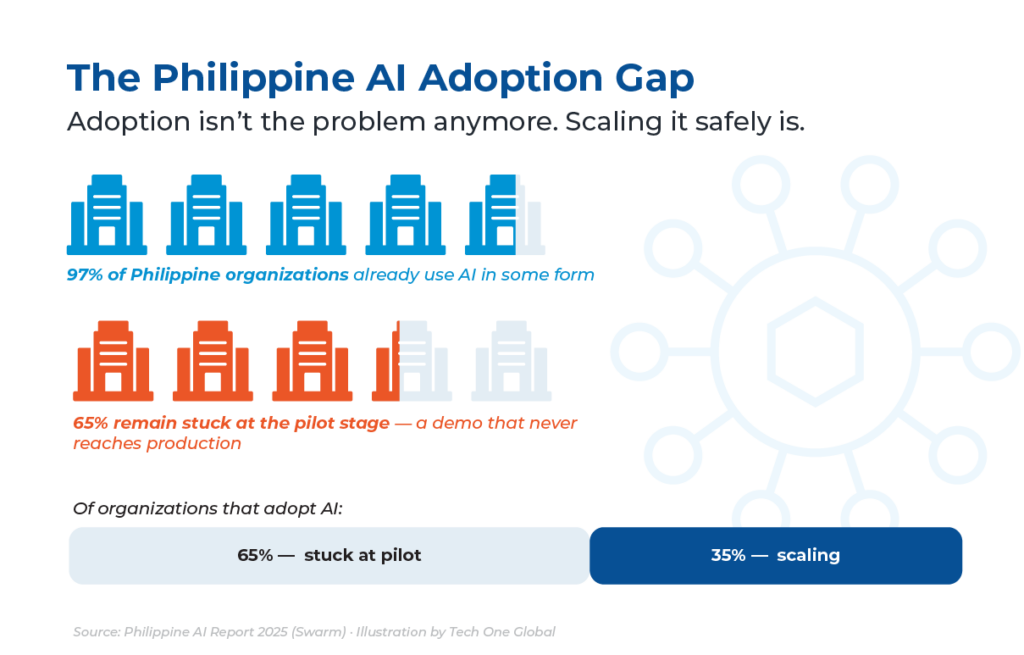
But there is a wide gap between talking about AI and actually scaling it. The Philippine AI Report 2025 found that more than 92% of local organizations have used AI in some form, yet roughly two-thirds are still stuck at the proof-of-concept stage. Adoption is no longer the problem. Turning experimentation into something the business can safely run on is.
In our work with Philippine organizations across finance, manufacturing, government, and the enterprise mid-market, one pattern shows up again and again: AI accelerates whatever it touches. Well-governed data becomes more valuable. Loose access controls become more exposed. Strong security foundations open the door to innovation, while weak ones quietly become the thing that stalls it.
That is why secure AI adoption has moved out of the IT department and onto the leadership table. The organizations getting the most out of AI are not the ones moving fastest. They are the ones who built the right foundation before they scaled.
AI Isn’t Creating New Risks. It’s Exposing the Ones You Already Had.
There is a common misconception that AI itself is the risk. In practice, AI usually just turns up the volume on problems that were already there.
If employees can reach information they were never meant to see, AI helps them find it faster. If sensitive files are oversharing across a tenant, AI makes them easier to surface. If governance has been fuzzy for years, AI spreads that inconsistency across every team at once.
Suddenly the questions nobody wanted to own become urgent. Who actually has access to what? Are those permissions still appropriate? What should these tools be allowed to touch, and how do we keep sensitive data protected once they can?
These are not only security questions. They are business questions, and they are landing harder as companies move from “let’s try AI” to “AI is now part of how we operate.” Microsoft points to the same short list of risks organizations need to get ahead of: unintended data exposure, compromised intellectual property, and attacks that manipulate data or model behavior.
The local threat backdrop makes this less theoretical. Fortinet found that around 94% of Philippine organizations experienced at least one breach in the past year, and 28% spent over US$3 million recovering. Layer AI on top of an environment like that without fixing the fundamentals, and you are not innovating — you are scaling your exposure.
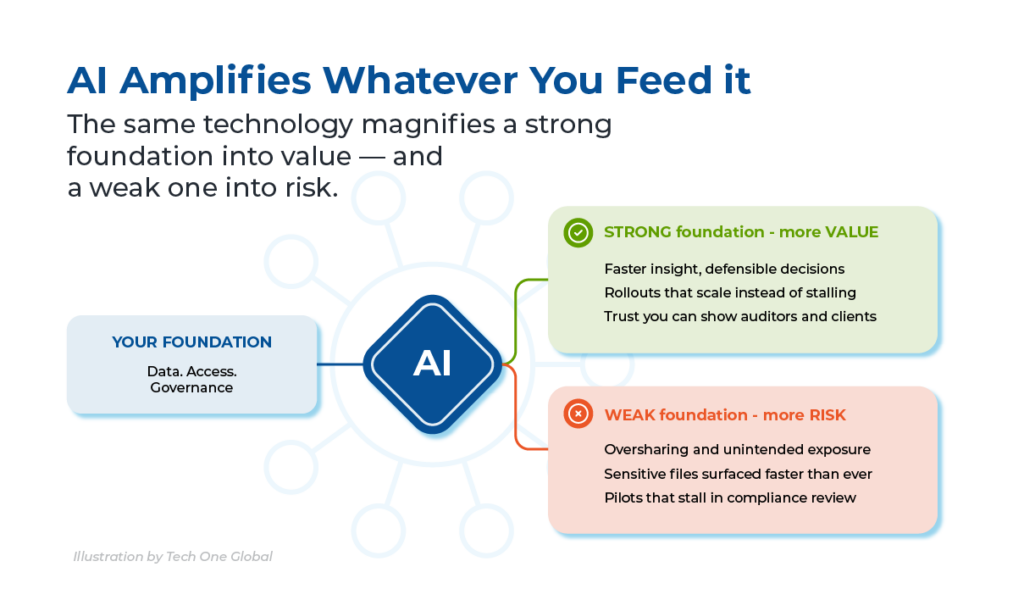
AI magnifies your existing foundation — in both directions
The Pressure to Move Fast Is Real — and So Is the Cost of Moving Blindly
Leaders cannot afford to sit AI out. Employees are already using AI tools, with or without approval. Competitors are investing. Customers expect faster, smarter service. The urgency is legitimate.
At the same time, security and compliance teams are being told to make sure all of this happens responsibly. That tension — go faster, but do not break anything — is exactly where many Philippine organizations get stuck. How do you encourage innovation without multiplying risk? How do you empower people without exposing sensitive information? How do you put governance in place without grinding adoption to a halt?
Microsoft frames the answer as doing two things at once: accelerating adoption while putting the controls in place to secure identities, data, applications, and AI workloads. The point worth sitting with is that this is not a trade-off between innovation and security. Handled well, each one makes the other possible. Shadow AI proves it — when governance lags, people route around it, and the 2025 IBM Cost of a Data Breach report found that unsanctioned AI use and missing governance are now measurably driving breach costs up.
In the Philippines, Security by Design Is Now a Compliance Requirement
For years, security was something you reviewed near the end of a project — a checkbox before go-live. AI breaks that model, because of the speed and scale at which it reaches into your information.
Locally, this is no longer just good practice; it is the direction regulation is already pointing. In December 2024, the National Privacy Commission issued Advisory No. 2024-04, applying the Data Privacy Act to the entire AI lifecycle — development, training, testing, deployment, and everyday use. For any organization processing personal data with AI, that means privacy impact assessments, real governance frameworks, and transparency with data subjects are not optional extras. The NPC has signaled compliance reviews for higher-risk AI systems, and penalties for serious violations reach into the millions of pesos. Its 2025 cease-and-desist order against a biometric-data operator was a clear reminder that the Commission is willing to act.
Security by design is simply the practical response to all of this. It means understanding your data before you connect it to AI, reviewing identities and permissions before you grant access, defining governance before employees start using new tools, and establishing accountability before AI gets embedded in a business process. Organizations that work this way tend to scale faster, not slower, because they remove uncertainty before it turns into an incident, an audit finding, or a headline.
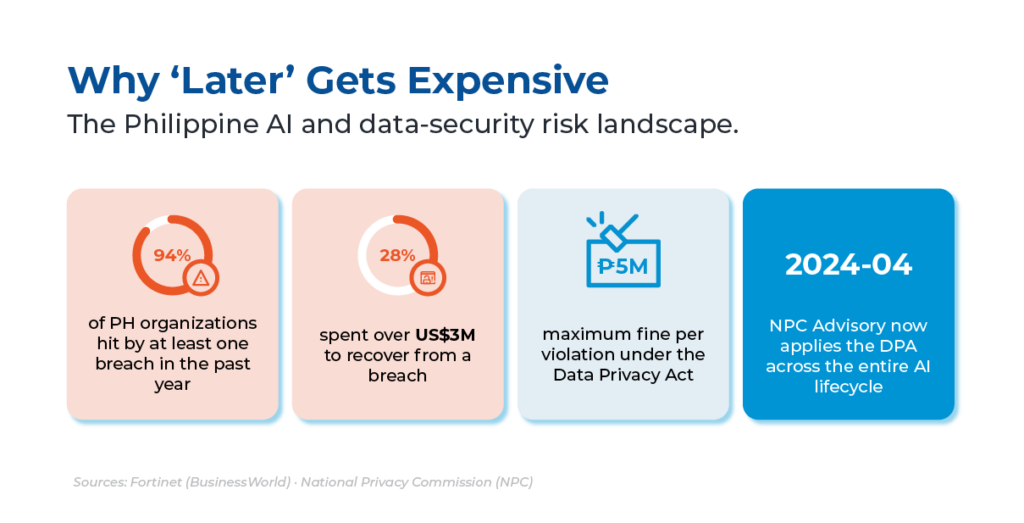
The cost of treating security as an afterthought, in Philippine terms.
The Trust-to-Scale Framework: What Separates AI Pilots That Ship From the Ones That Stall
Here is the uncomfortable part of that 65% figure: the pilots stuck in limbo are rarely stuck on the technology. They stall in the gap between a working demo and a production rollout the business can actually trust — and that gap is almost always about security, access, and accountability, not model performance.
Across the Philippine organizations we work with, three questions decide whether an AI pilot crosses that gap or quietly dies in it. We think of them as gates. Clear all three and scaling becomes a decision, not a gamble.
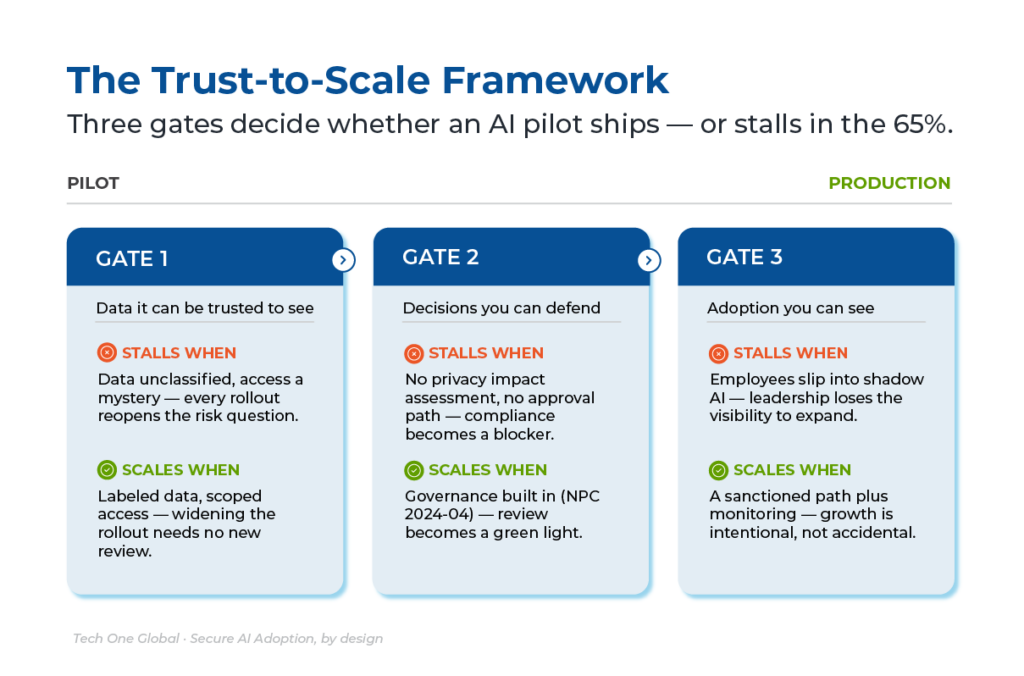
Gate 1 — Data the AI can be trusted to see.
Every time you widen an AI rollout, someone asks: “wait, can it access that?” How fast you can answer decides how fast you can scale.
- Stalls when: sensitive data is unclassified and permissions are a mystery, so each expansion reopens the risk conversation from zero.
- Scales when: data is labeled and access is scoped ahead of time, so widening the rollout doesn’t trigger a new security review every time.
Gate 2 — Decisions you can defend.
AI pilots don’t usually die in the IT team. They die in legal, compliance, or risk review — when no one can explain how the system handles personal data.
- Stalls when: there’s no privacy impact assessment and no clear approval path, so compliance becomes an open-ended blocker.
- Scales when: governance is built in from the start — PIAs and documented approvals aligned to NPC Advisory 2024-04 — so review turns into a green light instead of a wall.
Gate 3 — Adoption you can actually see.
The quiet killer isn’t a pilot that fails. It’s a dozen unsanctioned ones the leadership team never approved and can’t see.
- Stalls when: employees route around slow official tools into shadow AI, and leadership loses the visibility needed to expand with confidence.
- Scales when: there’s a sanctioned path plus monitoring, so growth is intentional and every new use case builds on a foundation you can trust.
What this looks like in practice. Take a common Gate 1 scenario. An organization rolls out Microsoft 365 Copilot to speed up everyday work. Within days, an employee asks it a routine question, and Copilot helpfully surfaces a salary spreadsheet or a board deck the person was never meant to see. Nothing was hacked. Copilot simply had access to a file that had been overshared long before AI entered the picture. The organizations that cleared Gate 1 first — classifying sensitive data and tightening access — never reach that moment, so their rollout keeps moving. The ones that skipped straight to deployment hit the wall, pause everything, and land back in the 65%. Same technology, very different outcome — decided entirely by what was built before the pilot went live.
Data Is the Real Starting Point for AI Security
Gate 1 is worth a closer look, because when organizations ask where to begin, the honest answer is rarely the AI tool itself. It is the data underneath it. AI is only ever as good — and as safe — as the information it can reach. If sensitive data is not properly classified, protected, and governed, AI adoption raises the odds of oversharing and unintended exposure rather than lowering them.
Microsoft’s guidance lines up with this: classify and protect sensitive data, extend those protection policies to your AI applications, and keep visibility into how AI is actually interacting with company information. Before deploying anything, it is worth pressure-testing a few basics. Do you know where your sensitive information lives? Do you know who can access it? Are those permissions still tied to a genuine business need? Have your data protection policies kept up with how people actually work now?
None of that is as exciting as a live demo. But it is usually what separates an AI initiative that lasts from one that quietly gets shelved.
Why Zero Trust Matters More in an AI-Driven Business
As AI works its way into everyday tasks, the old assumptions about trust get harder to defend. This is where Zero Trust earns its keep. The principle is simple: do not grant access just because a user, device, or application is already “inside.” Verify continuously, based on identity, context, risk, and genuine business need.
Microsoft’s secure AI guidance leans heavily on applying Zero Trust across identities, access, data, and AI-enabled environments — and it is a particularly good fit for the Philippine reality, where third-party and supply-chain exposure has been a recurring source of breaches. For organizations investing in AI, Zero Trust is not there to slow people down. It is there to make confidence possible: confidence that sensitive information stays protected, that access is appropriate, and that AI operates inside clearly defined guardrails.
Trust Will Decide Which AI Strategies Win
AI capabilities will keep evolving fast: new tools, more capable platforms, higher expectations from both employees and customers. What will not change is how much trust matters.
The organizations that can show strong governance, responsible AI practices, and solid security controls will be the ones positioned to scale AI with confidence. Because in the end, successful AI adoption was never really about deploying technology. It was about building an environment where people can use that technology safely, responsibly, and well.
That is why the AI conversation keeps circling back to security — not as a brake on innovation, but as the thing that lets you keep moving without losing control. The organizations that win the next few years will be the ones that scale AI without scaling their risk. And that starts with building security in from day one.
About Tech One Global Philippines
As organizations move deeper into AI, the question is no longer whether to explore it. It is how to scale it responsibly while protecting data, staying compliant with the Data Privacy Act, and keeping stakeholder trust intact.
Tech One Global helps Philippine organizations do exactly that. As a Microsoft Solutions Partner holding all six Solutions Partner designations — including Security, Modern Work, and Data & AI — and recognized four times as Microsoft Country Partner of the Year in the Philippines, we bring together expertise in AI, cybersecurity, governance, and modern workplace technology to help you build the foundations for secure, confident AI adoption.
Ready to accelerate AI adoption without accelerating your risk?
Talk to our experts about assessing your organization’s AI readiness, strengthening your security and data-governance controls, and building a foundation for responsible AI innovation — one that stands up to both attackers and auditors.
Source
Microsoft — Secure AI adoption (Zero Trust)
National Privacy Commission — Advisories & Circulars (Advisory 2024-04)
Philippine AI Report 2025 (Swarm)