AI Adoption Is a Business Transformation Effort — Not an IT Rollout
Why Philippine organizations need more than tools, training, and pilots to turn AI into measurable business value.
AI adoption usually gets introduced as a technology project. A tool is switched on, licenses are handed out, a few teams are trained, and everyone waits for productivity to climb. Sometimes it does. Often it doesn’t — not because the technology fell short, but because using a tool and changing how the business works are two very different things.
The opportunity is real, and for the Philippines it is unusually large. Accenture estimates AI could unlock as much as US$79 billion in productive capacity here, roughly a fifth of the country’s 2022 GDP. Filipino organizations sense it too: in Sprout’s 2025 research, 89% said AI adoption is critical to staying competitive. The question is no longer whether to adopt AI. It is why so much adoption produces so little measurable value.
That gap is the whole subject of this piece, and closing it starts with a reframe: AI adoption is a business transformation effort, not an IT rollout. The goal isn’t to deploy tools. It is to change how work gets done, how decisions get made, and how customers get served — and to be able to show, in the numbers, that any of it actually worked.
The Real Problem Isn’t Adoption. It’s the Usage–Value Gap.
Across industries, awareness stopped being the challenge a while ago. Almost everyone is experimenting. The hard part is turning that experimentation into consistent, governed, measurable value — and that is where most organizations are stuck.
McKinsey’s 2025 State of AI survey put hard numbers on it. 88% of organizations now use AI regularly in at least one function, but only about 39% report any enterprise-level impact on profit, and just 6% qualify as high performers earning real financial returns. Nearly two-thirds haven’t begun scaling AI across the enterprise at all. The uncomfortable takeaway from the data is that the other 94% don’t have a model problem — they have a value problem, because the leaders and the laggards are largely using the same tools.
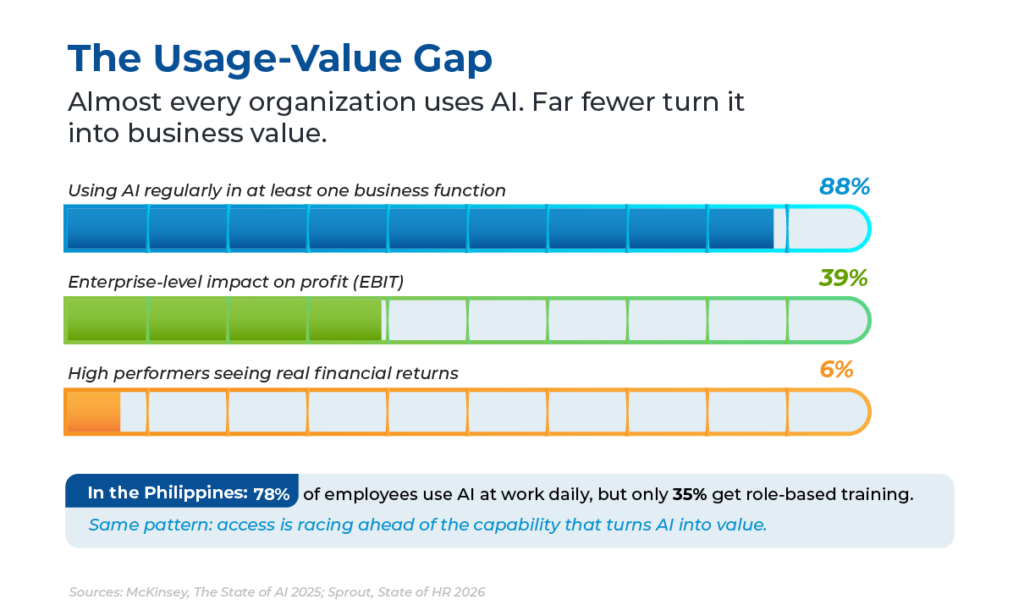
The Philippine picture rhymes with this and adds a local wrinkle. Sprout’s State of HR 2026 report found that 78% of Filipino employees now use AI every day at work, but only 35% receive any role-specific AI training from their employer. People are adopting AI faster than their organizations are teaching them to use it well. Access is running ahead of capability — and capability is what value depends on.
AI Adoption Is Really an Operating-Model Conversation
When AI is treated as a tool rollout, success gets measured by access: licenses assigned, sessions attended, use cases discussed. Those are useful signals, but they describe activity, not outcomes.
A transformation lens asks harder questions. Which processes should actually change? Which decisions could be sharper? Which teams need to work differently? What data should AI be allowed to touch, and who owns the result when it does? Those questions move AI out of the IT backlog and into the operating model — where ownership, workflow, governance, incentives, and measurement all live. That shift, more than any feature, is what separates organizations that get value from AI and organizations that just get invoices for it.
From AI Rollout to AI Transformation
The difference shows up in nearly every decision. A rollout assigns licenses; a transformation starts from the business priorities and high-value workflows those licenses are meant to serve. A rollout runs generic training; a transformation builds role-based capability. A rollout celebrates a promising pilot; a transformation turns that pilot into a repeatable way of working. A rollout measures activity; a transformation measures productivity, quality, cycle time, risk, and customer impact. And a rollout bolts governance on at the end, while a transformation designs data access and accountability in from the start — which is exactly what lets a business scale without flinching.
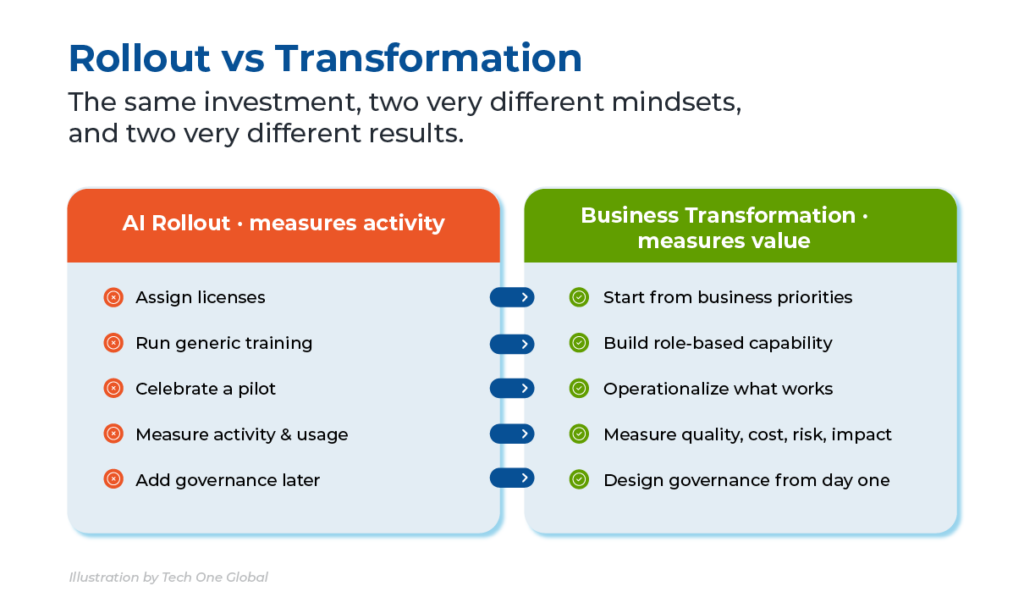
Same investment, two mindsets — activity on one side, business value on the other.
The AI Value Ladder: Access → Habit → Transformation
If there is one way to picture the journey, it is a ladder with three rungs. Most organizations believe they have “adopted AI” when they have really only reached the first one.
Rung 1 — Access. AI is available. Licenses are live, tools are open, people can log in. This feels like progress, and it is a necessary start — but on its own it changes nothing. The trap here is mistaking availability for adoption.
Rung 2 — Habit. People actually use AI, regularly, for real work: drafting, summarizing, analyzing, searching. Productivity improves in pockets. This is where most Filipino organizations sit today, and it is a genuine step up. The trap is that these gains stay individual and invisible — everyone is a little faster, but nothing shows up at the business level.
Rung 3 — Transformation. AI is built into how work actually flows, tied to business outcomes, governed, and measured. Value stops being anecdotal and starts appearing in cycle times, cost, quality, risk, and revenue. This is the rung McKinsey’s 6% of high performers reached — and they mostly got there by redesigning workflows, not by buying better tools.
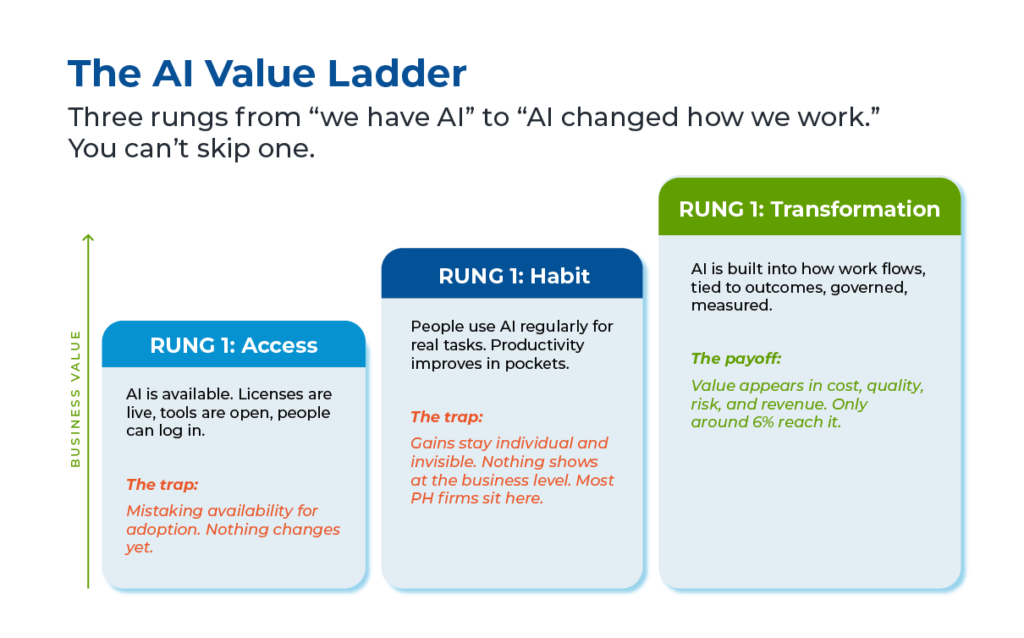
The AI Value Ladder: you can’t skip a rung, and you can’t buy your way up it.
The point of the ladder is that the climb from Habit to Transformation is organizational work, not a procurement decision. And that work runs on four levers.
The Four Levers That Move You Up the Ladder
Business Alignment. Start from business priorities, not tool features. Decide where AI is genuinely meant to move the needle — revenue, cost, customer experience, risk, speed — before deciding where to deploy it.
Workforce Enablement. This is the Philippines’ single biggest opportunity right now, given that 78%-use, 35%-trained gap. People need more than a one-off session: role-based guidance, real examples from their own work, safe prompting habits, and room to practice. Capability, not access, is what turns habit into value.
Workflow Redesign. This is the lever McKinsey found matters most — fundamental workflow redesign has the strongest link to profit impact, yet only about 21% of adopters have actually done it. Embedding AI into how approvals, reporting, service, or knowledge work really happen is where the real gains live. Bolting AI onto an unchanged process just makes an old process slightly faster.
Governance and Measurement. Adoption has to be secure, accountable, and measurable — and in the Philippines that is now a regulatory expectation, not just good practice. The National Privacy Commission’s Advisory 2024-04 applies the Data Privacy Act across the full AI lifecycle, and the government is finalizing its first National AI Governance Framework. Clear data-access rules, human oversight, and outcome metrics aren’t brakes on adoption; they are what lets leadership confidently say yes to scaling.
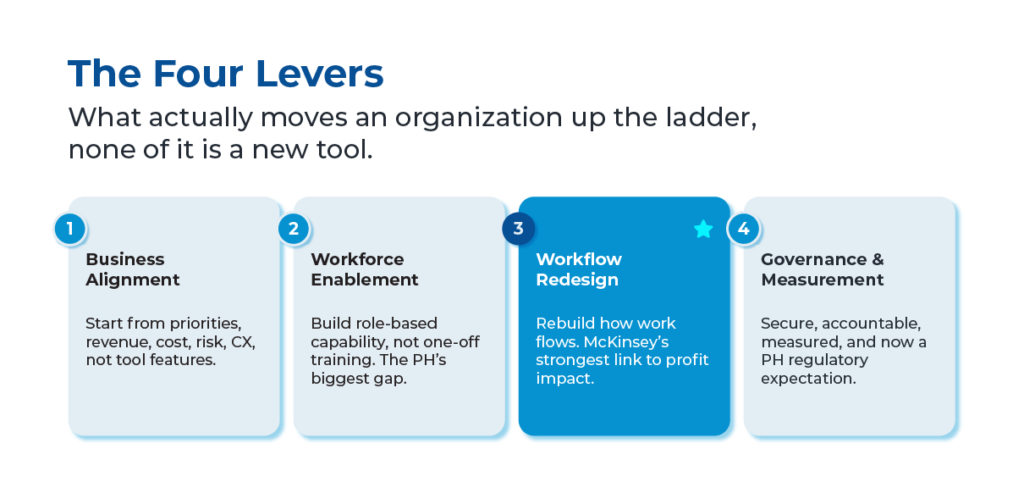
None of the four levers is a new tool. That is the whole point.
Why Pilots Stall Before They Scale
Most pilots look good in a controlled setting. They struggle the moment an organization tries to widen them across teams, data sources, and decision workflows. The usual culprits are familiar: unclear ownership, data that isn’t ready, users who were never really trained, governance added too late, no executive sponsor, and no agreed definition of success. Notice that none of those is a tool problem. Every one is a business-alignment or change-management problem — which is exactly why buying another tool rarely rescues a stalled pilot.
The Leader’s Role: Make AI a Business Priority
AI adoption becomes real when leaders treat it as part of the business agenda rather than a productivity tip. McKinsey’s high performers stand out for exactly this: senior leaders actively engaged, growth and innovation set as goals alongside efficiency, and workflows redesigned around AI. Leaders don’t need to approve every prompt or use case. They do need to set direction, clear blockers, define what responsible adoption looks like, and insist the organization measures outcomes that matter. In practice, that path runs in a recognizable order — assess readiness, prioritize high-value use cases, enable people by role, redesign the workflows that count, govern the whole thing, then measure and scale what works.
How Tech One Global Helps Organizations Move From Adoption to Impact
For organizations already invested in Microsoft 365 Copilot, Copilot Studio, Azure AI, Power Platform, or Microsoft Fabric, the next move is connecting those tools to a transformation roadmap rather than hoping value appears on its own. Tech One Global helps Philippine organizations do exactly that — combining business envisioning, role-based workforce enablement, use-case prioritization, secure implementation, and governance into an adoption plan with outcomes attached.
As a Microsoft Solutions Partner holding all six Solutions Partner Designations – Modern Work, Security, Data & AI (Azure), Digital & App Innovation (Azure), Infrastructure (Azure), and Business Applications – and recognized four times as Microsoft Country Partner of the Year in the Philippines, we work with organizations in regulated and operationally complex industries — where adoption has to balance productivity with security, compliance, and real business impact.
Access Is Where AI Adoption Begins — Not Where It Pays Off
The organizations that pull ahead over the next few years won’t be the ones with the most licenses or the flashiest pilots. They will be the ones that climb the ladder — building capability, redesigning work, governing responsibly, and measuring what changes — until AI stops being a tool they bought and becomes a way they work. That is the difference between adopting AI and being transformed by it.
Ready to turn AI adoption into business transformation?
Start with the workflows, people, data, and decisions that matter most — then build the adoption strategy around them. Book an AI readiness or adoption conversation with Tech One Global Philippines.
Source
McKinsey — The State of AI (2025 Global Survey)
Sprout Solutions — State of HR / AI in the Philippines
Accenture — AI in the Philippines: The Talent Imperative
National Privacy Commission — Advisories & Circulars (Advisory 2024-04)
BusinessWorld — Building an AI-ready Philippines (DEPDev AI Governance Framework)