Copilot Agents: The Next Digital Workforce
How AI agents move organizations from individual assistance to governed, workflow-level execution.
For a couple of years now, most organizations have been learning to work with AI assistants. People use Copilot to summarize meetings, draft emails, dig up information, and get through the day a little faster. That first wave mattered — it put AI into the flow of work. But the next shift is bigger, and it changes the question leaders should be asking.
AI is moving from assistance to agency. Instead of only helping a person finish a task, a Copilot agent can be built around a specific business process — grounded in your organization’s knowledge, following defined instructions, taking scoped actions, and moving work forward with consistency. That is why agents are being called the next digital workforce: not a replacement for people, but a new layer of AI-powered capacity working alongside them.
For Filipino organizations, the timing is pointed. Most local firms already have people using AI daily — 78% of employees, by one 2026 count — but far fewer have turned that into anything the business can measure. Agents are how individual productivity starts becoming process-level value.
Why Copilot Agents Matter Now
Microsoft describes agents for Microsoft 365 Copilot as specialized AI assistants that extend Copilot for specific domains, knowledge sources, and actions — able to retrieve information, summarize data, and take actions like sending an email or updating a record, depending on how they’re designed and governed. The distinction is simple but important: Copilot helps an individual work faster; an agent helps a whole process work better.
That moves the leadership question. It is no longer just “how do we get employees using AI?” It becomes “which repeatable workflows should AI help us redesign?” — which, as anyone who has actually tried to scale AI knows, is where the real value has always been hiding.
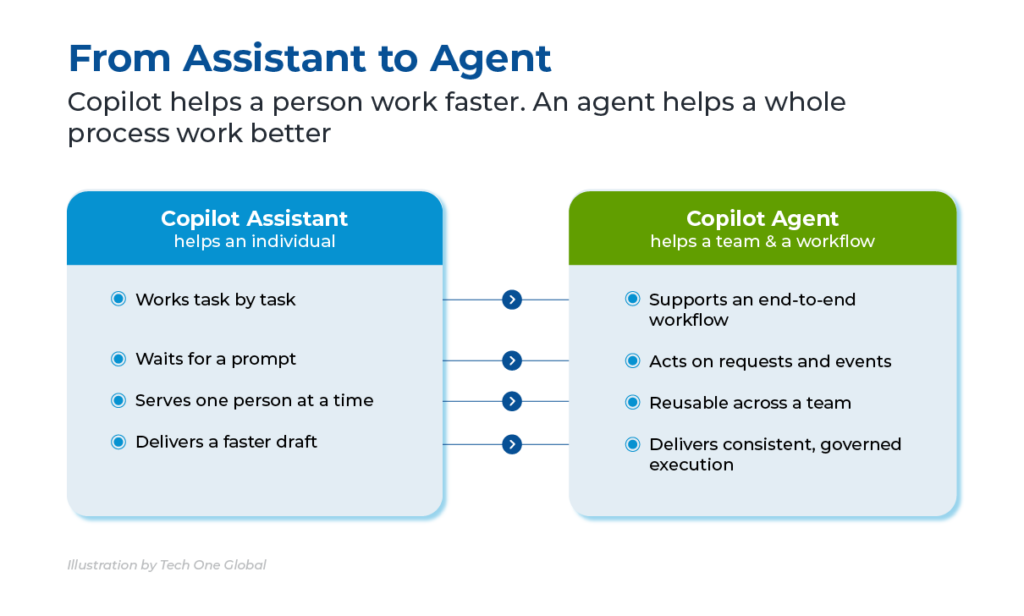
The shift that matters: from helping a person to supporting a whole workflow.
What a Copilot Agent Actually Is
Strip away the jargon and an agent is a specialized AI helper built around a defined task, process, or domain — grounded in specific knowledge, and able to follow instructions and take scoped actions inside Microsoft 365 or connected systems. It helps to hold three views of the same thing at once. To a user, it is a focused helper for a specific job. To the business, it is a reusable way to support a repeatable workflow. To security and compliance, it is a capability that needs clear access, ownership, and lifecycle controls. All three views are correct — and a serious agent program keeps them in the room together.
The Business Impact: What This Is Actually Worth
Agents don’t start from zero. They build on Copilot, whose business impact has now been measured — and that measured value is effectively the floor.
A Forrester Total Economic Impact study commissioned by Microsoft modeled a composite enterprise at 116% three-year ROI, with users saving around nine hours a month — most of it recaptured from content creation, information search, and meeting summaries. A separate Forrester study put ROI as high as 353% for small and mid-size businesses in a high-impact scenario, and independent usage studies consistently land in the range of 14 to 26 minutes saved per employee, per day. New-hire onboarding sped up by as much as 25%.
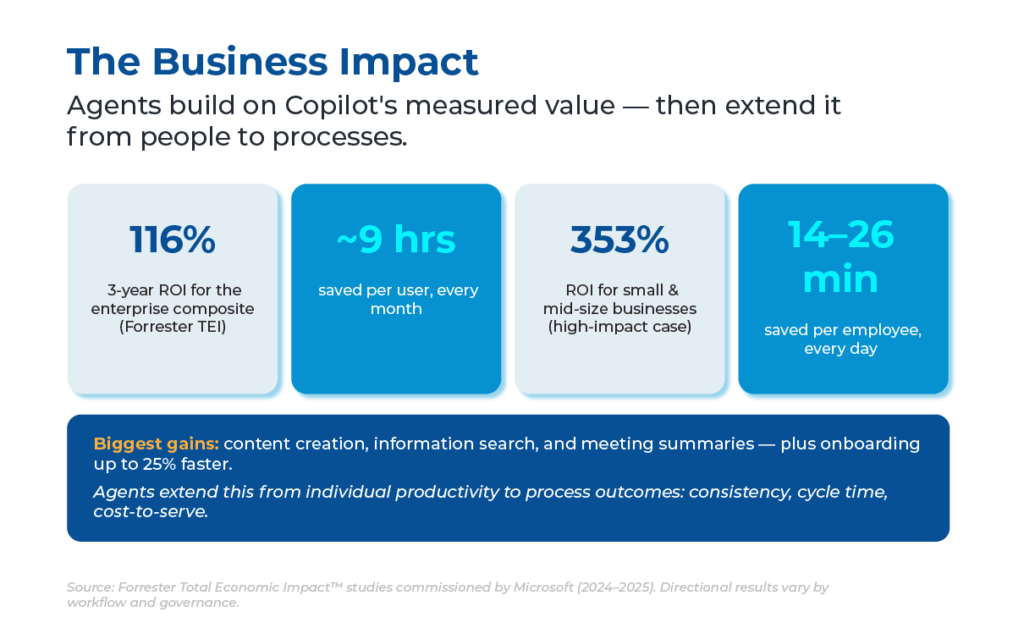
The measured value of Copilot is the floor; agents extend it from people to processes.
Two things are worth saying plainly. First, these are directional figures from vendor-commissioned studies, and real results depend heavily on which workflows you choose and how well you govern them — which is the whole point of this article. Second, and more importantly, those numbers mostly describe Copilot as an individual assistant. Agents extend that value from a person to a process. When an agent handles intake, triage, or follow-up consistently across a team, the gains stop being “minutes saved per person” and start showing up as shorter cycle times, lower cost-to-serve, and more consistent quality. Forrester calls agentic AI the “second wave” of this transformation for a reason.
For the Philippines, that second wave lands on familiar ground. The country’s IT-BPM sector — over 1.9 million people and roughly US$40 billion in annual revenue — is built on exactly the kind of repeatable, knowledge-intensive service work where agents do their best work: summarizing customer history, retrieving approved answers, and supporting consistent escalation.
Where Copilot Agents Earn Their Keep
The strongest agent opportunities tend to share three traits: the work is repeatable, the data sources are known, and the outcome is clear. Within those bounds, useful candidates show up in almost every function — from qualifying campaign responses in sales, to validating requests against policy in finance, to answering common questions in HR, to summarizing case history in customer service. The pattern is always the same: take repeatable, well-understood work and give it a consistent, governed support layer.
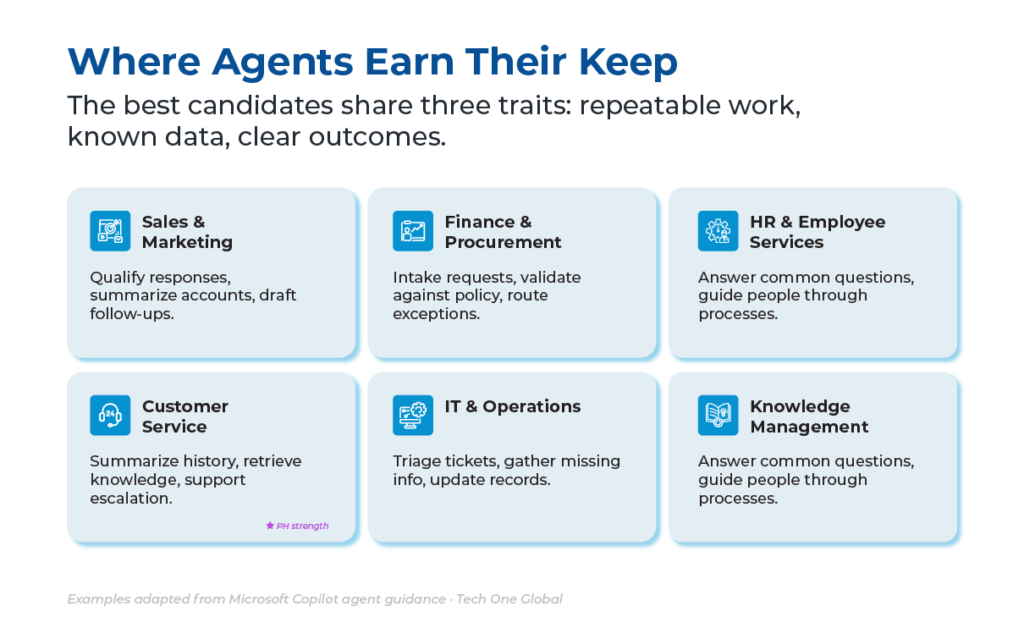
Agent-friendly work exists in every function — customer service especially, given the PH’s service economy.
The Agent Fit Test: Which Work Should Become an Agent?
Not every task should become an agent, and the fastest way to waste an AI budget is to build agents for work that was never suited to them. Before you build, run the work through four questions.
Repeatable. Does this work happen often, and roughly the same way each time? One-offs rarely earn back the effort of building and maintaining an agent.
Known data. Are the data sources the agent needs identified, accessible, and trustworthy? An agent grounded in messy or out-of-date data produces answers nobody trusts.
Clear outcome. Is “done well” defined clearly enough to measure? If you can’t measure the outcome, you can’t improve it — or govern it.
Bounded and supervised. Are the agent’s actions scoped, with a human checkpoint wherever real judgment is required? Guardrails are part of the design, not something you add after.
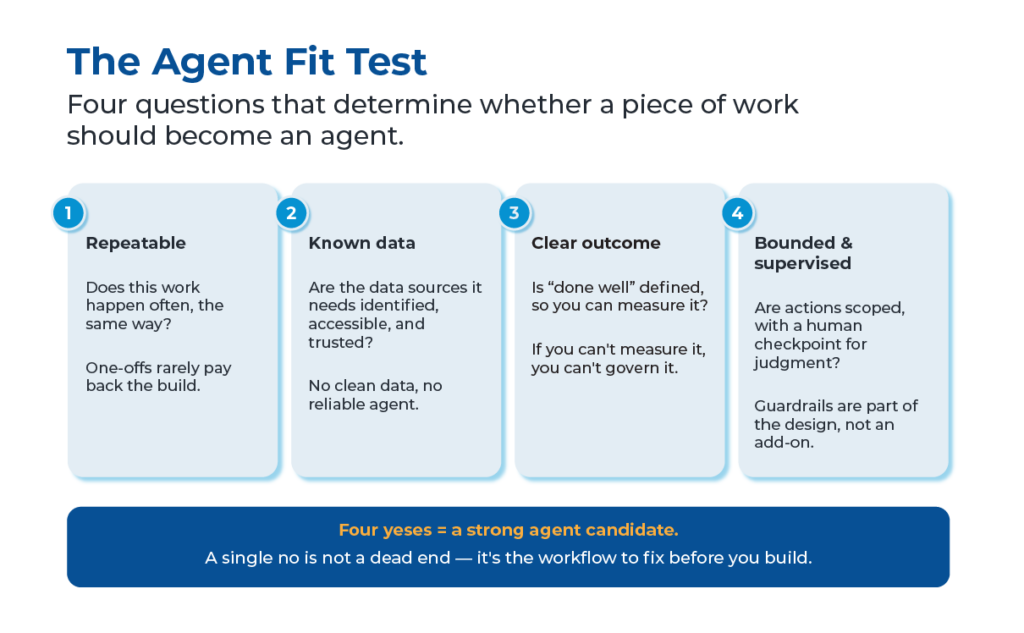
The Agent Fit Test: four yeses make a strong candidate; a single no shows what to fix first.
A single no isn’t a dead end — it’s usually a signal about what to fix before you build. Work that isn’t repeatable won’t pay back the effort; data that isn’t ready yields an agent nobody trusts; an outcome you can’t define is one you can’t measure; and actions without a human checkpoint are how a helpful agent quietly becomes a liability.
Why Governance Decides Whether Agents Scale
Agents get their power from being connected to real business data and processes — which is exactly why governance can’t be an afterthought. Microsoft’s own guidance flags the risks: an agent reaching information beyond what a user should see, confidential data being disclosed, or stale grounding producing confidently wrong answers. In the Philippines this isn’t only a best-practice concern. When an agent touches personal data, the National Privacy Commission’s Advisory 2024-04 applies the Data Privacy Act across the full AI lifecycle, and the government’s forthcoming National AI Governance Framework points in the same direction.
The practical answer is to define a short list before building each agent: its purpose, its scope (what it must never do), its approved knowledge sources, the actions it may take and which ones need human approval, the security and access controls that apply, how you will measure it, and who owns its lifecycle. That list is the difference between a trusted digital workforce and uncontrolled AI sprawl.
The Next Digital Workforce Is Human-Led and Agent-Supported
It helps to be honest about what agents are and aren’t. They are not magic workers, and they shouldn’t be sold as independent replacements for accountable teams. The truer framing is that agents are digital teammates for well-defined work — strongest when the organization understands the process, knows the data, sets the guardrails, and keeps people responsible for judgment, approval, and improvement.
That is also why this is an experience problem, not just an experimentation one. Building a single agent is easy. Building an agent ecosystem that employees trust, security teams will approve, and leaders can measure takes real delivery experience across adoption, governance, data, workflow design, and change management. It is why most organizations move in stages — from AI users who work confidently with Copilot, to AI makers who build agents and automations, to AI creators who develop scalable, well-governed solutions. You don’t jump from licenses to a production agent ecosystem overnight.
How Tech One Global Helps Build an Agent-Ready Workforce
Tech One Global helps Philippine organizations make that climb deliberately. We help identify where agents genuinely make sense, design them around real workflows, build with Microsoft tools such as Microsoft 365 Copilot, Copilot Studio, Power Platform, and Azure AI Foundry, and govern the environment with controls aligned to security, compliance, and adoption at scale.
As a Microsoft Solutions Partner holding all six Solutions Partner designations and a four-time Microsoft Country Partner of the Year in the Philippines, we work with organizations in regulated and operationally complex industries — where an agent has to be useful, secure, and accountable at the same time.
The Winners Won’t Build the Most Agents — They’ll Build the Right Ones
Copilot agents mark a new stage of AI adoption. The future of work isn’t only about people prompting better; it is about designing better ways for people, processes, data, and agents to work together. The organizations that pull ahead won’t be the ones with the most agents. They will be the ones that build the right agents, around the right workflows, with the right controls and the right measures of success — so the digital workforce becomes a genuine capability that cuts repetitive effort, raises consistency, and frees people for the work where human judgment matters most.
Ready to move from Copilot adoption to agent-ready transformation?
Start by identifying the repeatable workflows where agents can create measurable value — then build the governance and adoption model around them. Book a Copilot and Agents readiness conversation with Tech One Global Philippines.
Source
Microsoft Learn — Agents for Microsoft 365 Copilot
Microsoft — Secure and govern Copilot agents
Forrester — Total Economic Impact™ of Microsoft 365 Copilot
National Privacy Commission — Advisories & Circulars (Advisory 2024-04)
BusinessWorld — Building an AI-ready Philippines (DEPDev AI Governance Framework)