Bringing AI Closer to the Field: Microsoft Copilot in Energy Operations
In energy operations, work doesn’t stop at the office.
It happens across sites, systems, and teams—on the ground, in control rooms, and across corporate functions that need to stay aligned with what’s happening in the field. Every update, report, and decision depends on how quickly and clearly information moves between these layers.
And this is where challenges start to show.
Operational data sits in different systems. Site discussions don’t always turn into documented actions. Reporting takes time to piece together. And coordination between field teams and corporate stakeholders can become disconnected.
So the question isn’t whether teams have tools.
It’s whether those tools are actually working together in a way that supports real operations.
Bringing AI into a Real Operational Environment
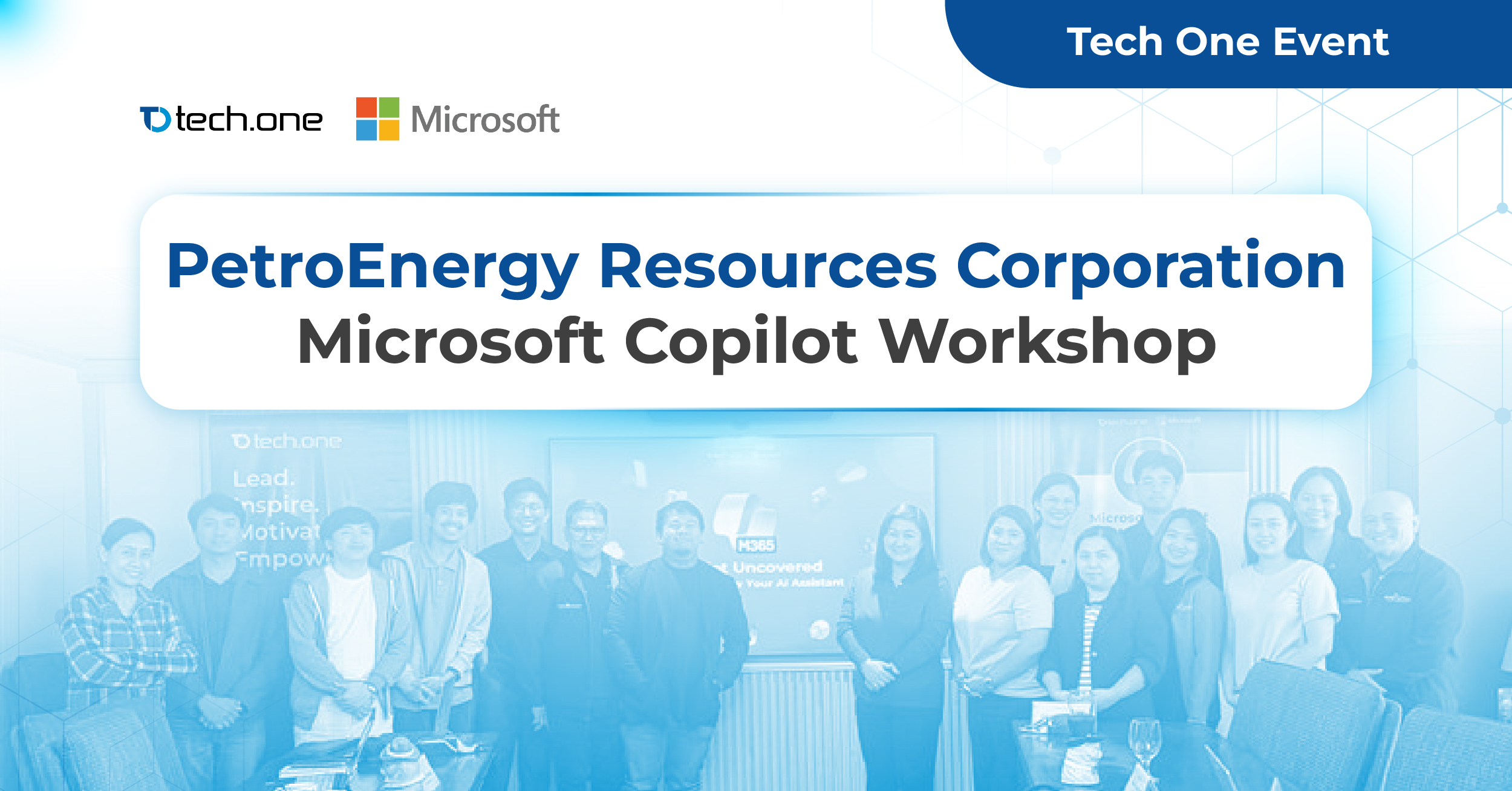
This was the focus of Tech One Global’s recent Microsoft Copilot workshop with an energy organization at their Maibarara Geothermal facility in Batangas.
Following an earlier session with their Manila-based team, this workshop was designed to move beyond awareness and into application—showing how AI can support the realities of an asset-heavy, operations-driven environment.
Led by Associate Solutions Architect Gab Limlingan, the session grounded Microsoft Copilot in actual day-to-day scenarios that teams face across operations, finance, and support functions. Not as a separate tool, but as something embedded into how work already gets done.
Where AI Starts to Make an Impact in Energy Operations
Instead of theoretical use cases, the session focused on situations that are familiar to teams working in power generation and resource-intensive industries.
- When operational and financial data are spread across systems
Teams often spend time pulling together updates from plant data, reports, spreadsheets, and emails. Copilot helps bring these into a single view within Microsoft 365, making it easier to build and review reports and analyses.
- When critical discussions happen on-site but are hard to track later
From technical meetings to cross-functional reviews, key context can get lost over time. With transcription and summarization, teams can capture discussions clearly and revisit them when needed.
- When reporting needs to be frequent, clear, and decision-ready
Whether for performance tracking, procurement, or executive updates, building reports from scratch takes time. Copilot helps generate structured outputs that teams can quickly refine.
- When coordination stretches across the field and corporate teams
Operations rely on constant alignment. Copilot helps reduce repetitive coordination work, making it easier to share updates, track progress, and stay on the same page
Designed for the Complexity of Operational Work
In environments like geothermal facilities, everything is connected.
A single update can affect maintenance planning, financial reporting, procurement, and leadership decisions. When information is delayed or incomplete, it impacts more than just one team.
This is where Copilot fits in naturally.
Working within Microsoft 365, it helps teams:
- Connect information across emails, reports, and technical documents without jumping between systems
- Automatically capture key discussions, reducing manual note-taking
- Simplify reporting workflows across departments
- Keep field teams and corporate stakeholders aligned with up-to-date information
- Support recurring tasks with simple, purpose-driven automation
Instead of adding another tool to manage, it helps make better use of what’s already there.
Built for Secure, Controlled Environments
For organizations in the energy sector, data is critical—not just for operations, but for compliance, financial reporting, and risk management.
Any adoption of AI needs to respect that.
Because Copilot is built within Microsoft 365, it operates within existing permissions and governance structures. This means:
- Teams only access the information they are authorized to see
- Data remains within the organization’s environment
- Outputs are grounded in internal, trusted sources
This allows organizations to explore AI while maintaining the level of control required in operational and regulated environments.
From Possibility to Practical Impact in Energy Operations
For teams operating in asset-heavy environments, AI only makes sense when it works the way they already do.
This session focused on that shift—from idea to application. Not adding new systems, but improving the ones teams rely on every day.
In operational settings where data comes from multiple sources and decisions need to be made quickly, the real value of AI shows up in small but critical areas:
- Less time spent consolidating and formatting reports
- More reliable documentation of site discussions and activities
- Faster access to operational and business insights
- Stronger alignment between field teams and corporate decision-makers
The goal is simple. Reduce friction, not add to it.
When applied this way, AI becomes part of the workflow—not something separate. It helps teams capture what’s happening on the ground, connect it to business decisions, and act on it with more clarity and confidence.
See How This Can Work in Your Operations
If your teams are managing distributed data, coordinating across sites, or building reports from multiple sources every day, AI should not add to the complexity.
It should help bring clarity to it.
At Tech One Global, we take a practical approach. We work closely with teams to understand their processes, identify inefficiencies, and apply solutions like Copilot in ways that improve visibility, reduce manual effort, and support better decision-making.
As a multi-awarded Microsoft country partner, we continue to support PERC beyond the workshop, working as a trusted partner as Copilot adoption evolves. This ensures that AI is implemented in a way that is practical, secure, and sustainable, helping teams move from initial awareness to confident, long-term use.
Let’s start the conversation.
📧 contact@techoneglobal.com
📞 +63 2 8782 4968