Secure E-Signatures for Philippine Banks and Financial Institutions
What to look for in a compliance-ready signing platform
Ask a compliance officer at a Philippine bank what makes a signed document defensible, and “the signature” is rarely the first thing they mention. What they talk about is the record around it — who was verified, how and when, and whether anyone can prove the file wasn’t altered after the fact.
That distinction sits at the center of nearly every e-signature decision in banking, lending, and insurance right now. Financial services here are going digital quickly: onboarding, loan releases, policy issuance, and board approvals are all moving off paper. But in a regulated environment, speed only counts if the resulting record holds up — in an internal review, a BSP examination, or a dispute years later.
Plenty of tools can drop a signature onto a PDF. Far fewer are built for the evidentiary weight a regulated institution actually carries: verified identity, proof the document never changed, a retrievable audit trail, and storage that respects your governance rules. For BFSI, that gap is the entire decision.
So the question isn’t “can we use e-signatures?” It’s the sharper one an auditor eventually asks: will this record stand up when we have to prove it?
Why digital signing carries higher stakes in BFSI
In most organizations, paper signing is a nuisance. In a bank, it’s a control point.
Documents still crawl through email chains, courier bags, and branch desks, and every handoff adds a day, a cost, and a place where a file can go missing or get signed by the wrong person. A misplaced consent form is an inconvenience for a retailer. For a lender, it’s a finding.
The pressure inside Philippine financial institutions comes from several directions at once. Customers expect the same friction-free experience they get from their e-wallet. Operations wants loan files closed faster. Compliance wants evidence it can actually produce on demand. And leadership wants transformation that doesn’t quietly open a new governance hole.
Across the digital transformation projects we’ve supported, the shift tends to follow the same arc. A team sets out to “remove the paper.” A few weeks in, the real goal surfaces: a signing process that’s consistent, secure, and defensible — one that produces the same clean record every time, whether the signer is in Makati or Mindanao.
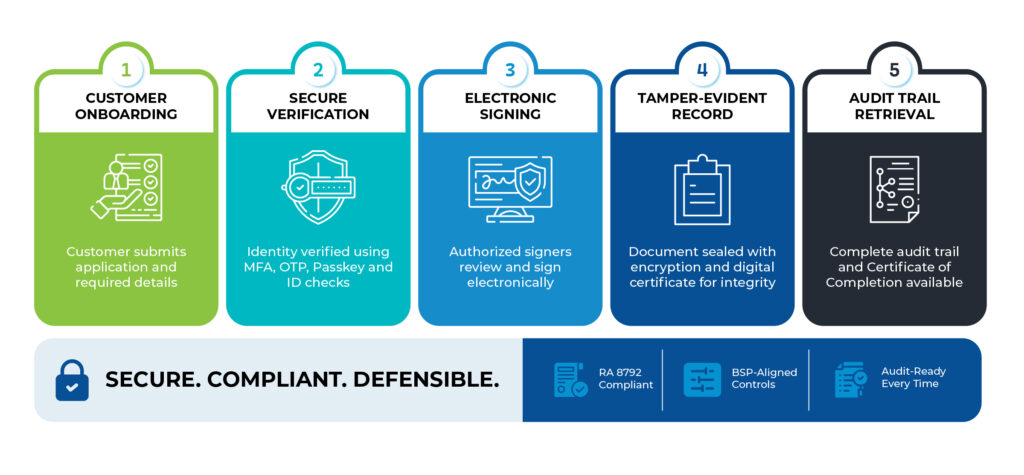
From paper-bound approvals to a secure, traceable flow — verification, signing, tamper-evident sealing, and audit-ready retrieval in one path.
Are electronic signatures legal in the Philippines?
Yes. Electronic signatures have been legally recognized here since 2000, under Republic Act No. 8792, the Electronic Commerce Act. The law gives electronic documents and signatures the same standing as their paper equivalents — provided the method used is reliable and appropriate to the transaction.
Banking adds its own layer. In December 2022, the Bangko Sentral ng Pilipinas issued Circular No. 1163, amending the miscellaneous rules on deposits under Section 276 of the Manual of Regulations for Banks. It confirms that banks may accept electronic signatures — alongside wet signatures or biometrics — when opening deposit accounts, and requires a minimum of three specimen signatures on file, executed on paper or electronically. The circular anchors this to Section 8 of RA 8792.
Here’s where teams get tripped up, though. Legality is the floor, not the finish line. RA 8792 doesn’t bless any electronic mark on sight; it ties enforceability to the reliability of the method. So the real test for a regulated institution isn’t whether e-signatures are allowed. It’s whether you can show, after the fact, who signed, what they signed, when they signed, and that the document hasn’t changed since.
Three questions a BFSI signing process has to answer
Strip away the feature lists and every compliance-ready signing workflow reduces to three questions. They’re the same ones a regulator, an auditor, or opposing counsel will eventually put to you — so it’s worth being able to answer them before they’re asked.
Can you prove who signed?
Identity should rest on more than access to an inbox. Look for OTP, MFA, and passkey sign-in, with step-up checks — including ID verification — for higher-risk transactions.
Can you prove nothing changed?
The executed file should carry its own proof of integrity: cryptographic hashing, sealing, and certificates that make any post-signing edit obvious at a glance.
Can you produce the whole record?
On request, you should be able to pull the full trail — timestamps, authentication steps, viewing and completion status, and a certificate for the finished document.
None of these are abstract legal points. They’re the practical difference between closing an audit in an afternoon and spending a week rebuilding a file out of email.
The three pillars of a defensible signing process: prove who signed, prove nothing changed, and prove the full story.
What you should look for in a secure e-signature platform
Ease of use sells the demo. It’s the unglamorous, full-lifecycle work — from signer verification to retrievability three years later — that decides whether a platform survives contact with your auditors. Five things worth weighing:
- Identity verification you can stand behind
An e-signature is only as trustworthy as the check that ties it to a real person, and email access alone doesn’t clear the bar for regulated work. Stronger options include:
- One-time passwords sent by SMS or email
- Multi-factor authentication for higher sign-in assurance
- Passkeys for phishing-resistant, passwordless signing
- ID document verification for higher-risk transactions, such as large credit approvals
- Document integrity and tamper evidence
Once signed, a document should visibly break if it’s altered. This matters most for the files people fight over later — loan agreements, policy contracts, board resolutions, consent records. Cryptographic hashing, document sealing, digital certificates, and encryption in transit and at rest are what turn “nothing changed” into a provable claim rather than a hope.
- A complete, readable audit trail
A good audit trail tells the document’s whole story without a forensics exercise. At minimum it should capture:
- Timestamps for each key signing event
- The authentication steps taken by each signer
- Viewing and completion status
- Device or session context, where available
- A certificate or completion summary for the executed file
The payoff shows up during an exam or a dispute, when you can hand over the record instead of reconstructing it.
- Security and data protection that fit your policies
BFSI platforms handle some of the most sensitive data an institution holds, so the signing tool should answer to your existing controls — not the reverse. Look closely at how records are stored, who can access them, how completed documents are protected, and whether all of it can be governed centrally. A platform that can’t map to your access and retention policies quietly becomes a shadow system.
- Integration with the systems you already run
An e-signature tool earns its keep when it disappears into existing workflows instead of becoming one more login. For most Philippine BFSI teams that means sitting alongside Microsoft 365 and SharePoint, plus the CRM, loan origination, policy administration, and onboarding systems where the work actually happens.
Where the value actually lands
The gains aren’t evenly distributed — secure signing pays off fastest wherever identity and evidence carry weight. A few of the highest-return areas across BFSI:
| Area | Common Signing Workflows | What the Institution Gets |
|---|---|---|
| Banking & Lending | Account opening, loan applications, credit approvals, consent forms | Faster releases without losing the identity and approval evidence examiners ask for |
| Insurance | Policy issuance, endorsements, claims sign-offs, customer acknowledgments | Quicker policy and claims cycles, with cleaner documentation behind each decision |
| Corporate Governance | Board resolutions, policy approvals, vendor contracts, procurement | Approval records that are easy to locate when a review lands |
| HR, Legal & Shared Services | Employment papers, NDAs, quitclaims, vendor onboarding, internal forms | Less paper moving between branches and distributed teams — and less chasing |
Where Evia Sign fits
Evia Sign is built for organizations that need signing to be traceable and audit-ready, not merely quick — which is precisely the bar BFSI operates at. For Philippine banks, lenders, and insurers, the capabilities that tend to matter most are the ones tied to evidence:
- OTP, MFA, and passkey authentication to establish who signed
- End-to-end audit trails that document the full signing journey
- Certificate of Completion records for every finished transaction
- Encryption and integrity controls that protect the document after signing
- Native Microsoft 365 and SharePoint integration for teams already working in that environment
- API connectivity to wire signing into enterprise and line-of-business systems
The through-line is control: digitize the workflow without giving up the evidence, governance, and continuity a regulated institution can’t operate without.
Why the implementation partner matters as much as the tool
Rolling out e-signatures well is less a software install than a change-management project. The technology is the easy part. The harder questions — which documents to digitize first, which workflows need stronger identity controls, which records must stay retrievable for compliance — are answered by process, not by a product page.
This is where Tech One Global comes in. As a Microsoft Solutions Partner holding all six designations, and a four-time Microsoft Country Partner of the Year in the Philippines, we implement signing the way regulated institutions need it done: mapped to real workflows, fitted to your existing Microsoft environment, and aligned to your integration and compliance requirements from day one. Having supported digital transformation across BFSI and other regulated sectors in Asia, we keep seeing the same pattern — the projects that succeed treat evidence and governance as design inputs, not afterthoughts.
The bottom line
Electronic signatures are already part of how financial services get delivered in the Philippines. The open question was never whether to leave paper behind — it’s how to do it without weakening the controls that keep a signed record defensible: verified identity, document integrity, a complete audit trail, sound security, and clean integration.
Get those right and e-signing does two things at once. It makes the customer experience faster, and it makes the record stronger. Evia Sign is built for institutions that refuse to trade one for the other.
If your signing processes need to be fast, secure, and defensible in equal measure, let’s map out what an audit-ready workflow looks like for your organization.
Talk to a Tech One Global BFSI specialist about secure, audit-ready signing with Evia Sign.
Source
Microsoft Learn — Agents for Microsoft 365 Copilot
Microsoft — Secure and govern Copilot agents
Forrester — Total Economic Impact™ of Microsoft 365 Copilot
National Privacy Commission — Advisories & Circulars (Advisory 2024-04)
BusinessWorld — Building an AI-ready Philippines (DEPDev AI Governance Framework)