Why Unified Data Creates Better AI Outcomes
Filipino organizations are investing in AI faster than ever. Yet the results often fall short — and the reason is rarely the model. It’s the data underneath it
The central idea
Trusted data enables trusted AI, which enables trusted outcomes.
The Real Reason AI Projects Struggle
Across boardrooms in Metro Manila, Cebu and Davao, a version of the same question keeps surfacing — usually from a CEO or CFO who has already approved the budget: the tools are in place, the pilots have run, so why doesn’t the transformation feel transformational? The honest answer is rarely comfortable. In most cases the AI is doing exactly what it was asked. The problem is what it was given to work with.
AI does not create intelligence from nothing. It amplifies whatever information it can reach. Feed it clean, connected, trusted data and it compounds your advantage. Feed it the reality inside most organizations — the same customer recorded four different ways across core banking, the cards platform, the loyalty app and a spreadsheet someone still maintains by hand — and it amplifies the mess just as efficiently. Fragmented, duplicated, incomplete or inconsistent data does not stay a back-office problem once AI scales it into every decision.
This is especially true in the Philippines, where the gap isn’t access — it’s readiness. Government data shows 90.8% of local establishments own computers and 81% have internet access, yet only about 15% actually use AI tools, and formal AI adoption across industries sits near 3%. We are one of the most connected markets in the region and one of the least converted. The bottleneck is no longer technology. It’s whether the underlying data foundation can support what leaders want AI to do.
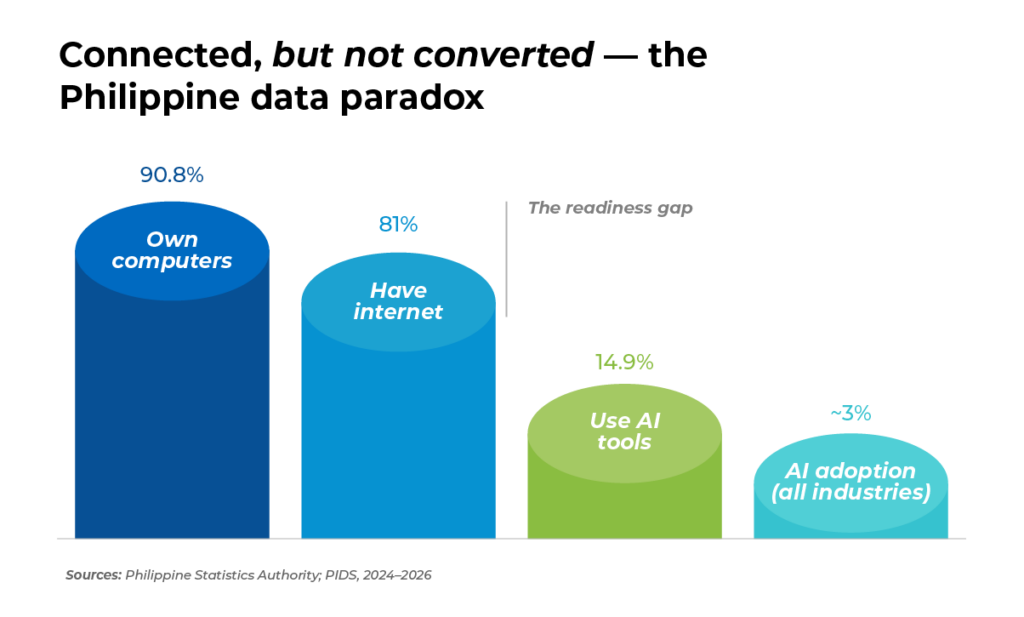
Connected, but not converted — the Philippine data paradox. Sources: PSA; PIDS, 2024–2026.
The Failure Isn't the Model. It's the Foundation.
When an AI initiative disappoints, the instinct is to interrogate the technology — the platform, the model, the implementation partner. The independent evidence points somewhere far less glamorous. A widely cited 2025 study from MIT’s Project NANDA found that 95% of organizations deploying generative AI saw zero measurable return — not a modest return, none — while a narrow 5% captured real value. RAND’s analysis of thousands of enterprise initiatives put the failure rate above 80%, roughly double the rate of conventional IT projects.
Look at what the successful minority did differently and the pattern is consistent: they fixed the data before they scaled the AI. Gartner projects that 60% of AI projects unsupported by AI-ready data will be abandoned, and in a 2025 KPMG survey, 85% of leaders named data quality as their single biggest obstacle to an AI strategy. Models have largely become a commodity — several are excellent and broadly available. The durable differentiator is the quality of what you feed them.
“AI doesn’t solve your data problems. It exposes them — at scale, in production, in front of your board.”
The Hidden Cost of Data Fragmentation
Most enterprises don’t suffer from a shortage of data. They suffer from a shortage of agreement. Customer, financial, and operational information lives across separate systems, spreadsheets, and departmental repositories — each version technically defensible, none of them reconciling cleanly with the others.
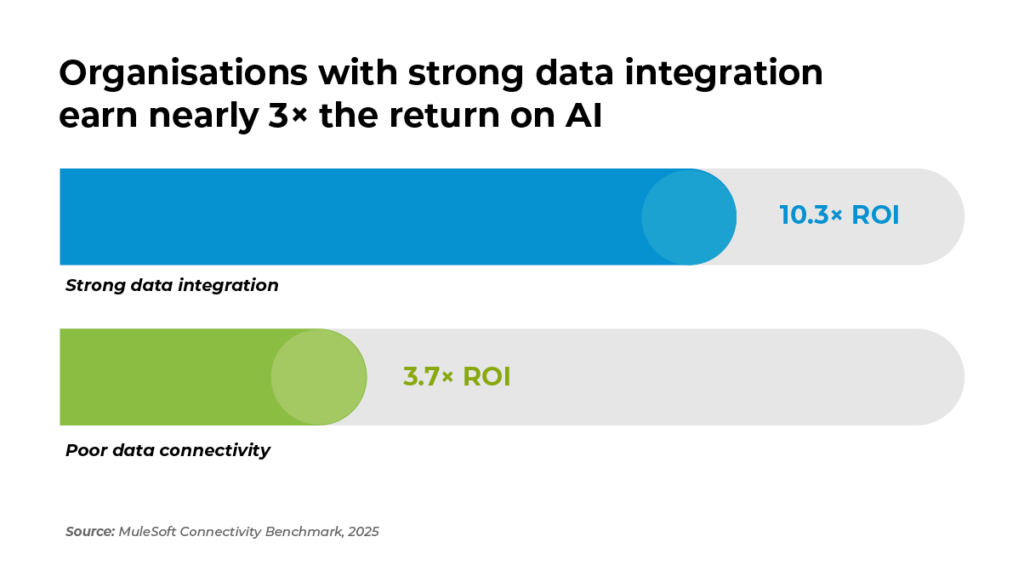
That disagreement carries a price most organizations never put on the books. Industry benchmarking finds the average enterprise now runs close to 900 applications, and only about 29% of them are integrated — the rest are islands. Gartner estimates poor data quality costs organizations an average of 15% of revenue a year. For a bank or insurer, that isn’t an inconvenience; it’s a tax on every decision. Point AI at that estate and it doesn’t reconcile the conflict for you — it picks whichever source was convenient and produces an answer no one can defend to a regulator, an auditor, or a customer.
Here’s the part that should reframe the conversation: the return on AI is not evenly distributed. It tracks almost perfectly with how connected an organization’s data is.
The 3C Test: Is Your Data Actually AI-Ready?
Before evaluating any platform, a leadership team should ask whether its data is actually prepared for AI. The 3C Test is a simple diagnostic we use before committing a single peso to a build. Ask three questions — and if the answer to any of them is no, that’s where your AI outcomes are leaking.
1. Consolidated
Can AI access a complete picture?
2. Consistent
Can the organization trust it?
3. Contextual
Does the data carry business meaning?
“Is our data connected across the systems that matter — or scattered where AI can’t reach it?”
“Is our data governed, traceable and aligned, so the numbers agree with each other?”
“Do shared definitions explain what our key metrics actually mean?”
Data state
Connected across relevant systems
Data state
Connected across relevant systems
Data state
Connected across relevant systems
AI outcome it unlocks
Fewer blind spots and contradictions
AI outcome it unlocks
Defensible, auditable outputs
AI outcome it unlocks
AI reasons in business terms
You consolidate data so AI can see it. You make it consistent so AI can trust it. You add context so AI can understand it. The three build on one another — skip a stage and everything above it wobbles.
What It Takes to Build a Unified Data Foundation
Most executives already agree with the destination. Execution is where it gets hard. Historically, integration, governance, analytics and AI were each addressed as separate initiatives, with separate tools and separate owners — and every new tool bolted on to close one gap quietly opened another. Teams end up managing integration debt: more connectors, more copies, more places for the truth to drift.
Supporting enterprise-scale AI takes four things working together: connected data without needless duplication; consistent governance and visibility across the estate; shared business definitions and metrics; and a single foundation that can serve analytics and AI at once, rather than as competing projects. Stated plainly, that’s what “unified” has to mean before it means anything to an AI model.
That requirement — one governed foundation rather than a patchwork — is exactly what has driven the shift toward unified data platforms built for AI readiness.
Why Microsoft's AI Strategy Starts with Data
It’s worth noticing that Microsoft’s own modernization strategy now begins in the same place. Analytics, Copilot experiences and AI agents cannot operate reliably on information that is fragmented or poorly governed — so the recommended first move is no longer “migrate to the cloud.” It’s “establish trusted data.”
That principle shows up across three different Microsoft narratives — Microsoft Fabric, the Frontier Firm, and the FY27 Fab 4 motion. Different programs, same conclusion: trusted data comes first. When the same causal claim surfaces three times from three directions, it isn’t messaging alignment. It’s the underlying reality asserting itself.
Microsoft Fabric and the Foundation for AI
Microsoft Fabric brings data integration, warehousing, governance, analytics and AI into one environment, with a single company-wide data lake — OneLake — at its center. It’s a practical way to turn the 3C model from principle into execution.
The value isn’t the platform for its own sake. It’s that teams and AI tools finally work from the same connected, governed, meaningful information. OneLake holds data once, in open Delta Parquet format, and connects across clouds without endless copying — which means no vendor lock-in and far less spend moving data around. Governance, lineage and security are applied across the estate by default rather than bolted on. And semantic models carry shared business meaning, so Copilot and agents reason in your terms rather than raw tables.
3C principle
Microsoft Fabric capability
Business value
Consolidated
OneLake and connected data workloads — one tenant-wide lake in open format, no copying across clouds.
A more complete data foundation; no vendor lock-in.
Consistent
Governance, lineage, and security applied across the estate by default.
Trusted, traceable outputs you can defend.
Contextual
Semantic models and shared metrics that ground Copilot and agents.
AI grounded in business meaning.
Worth saying plainly, because it’s where over-promised projects come undone: Fabric gives you the foundation — it doesn’t excuse you from the discipline. You still need to define what success looks like before you build, assign ownership of your data, and keep quality honest. The platform makes the right path far easier to walk. It doesn’t walk it for you.
The Bigger Picture: From AI User to Frontier Firm
Microsoft’s Work Trend Index describes an emerging kind of organization it calls the Frontier Firm — built around human-agent teams, where AI increasingly executes work while people provide direction, oversight and judgment. In Microsoft’s research, employees at these firms are markedly more likely to say their organization is thriving than the global average. It’s a credible picture of where enterprise work is heading.
But there’s a prerequisite most of that conversation skips. An agent that acts on your behalf — approving a loan tier, flagging a suspicious transaction, drafting a client proposal — is only as dependable as the data beneath it. A Frontier Firm doesn’t run on clever agents; it runs on agents you can trust to act, and that trust is manufactured at the data layer. Point an agent at a fragmented estate and you haven’t built a Frontier Firm — you’ve automated the guesswork. Trusted agents require trusted data, which is why the journey begins with unified, governed and contextual information.
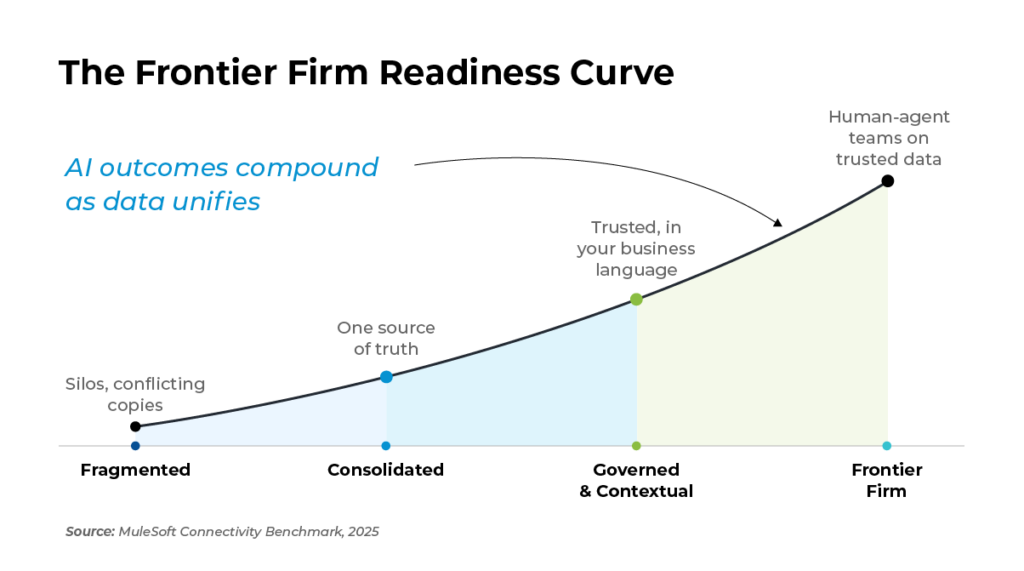
The Frontier Firm Readiness Curve — each stage of data maturity enables the next level of AI value.
Most Philippine enterprises we assess today sit between Fragmented and Consolidated. The leap in value doesn’t come from buying more AI — it comes from climbing the curve, each stage making the next one possible
Microsoft's Fab 4: A Blueprint for AI Readiness
Microsoft’s FY27 framework for growing and mid-market businesses — the Fab 4 — follows the same progression, and it opens with a line that removes the usual reason to wait: modernization doesn’t require cloud migration first. You can start where you are — on-premises, hybrid, or already in the cloud — and the recommended first step is establishing trusted data through Microsoft Fabric. From there, you expand into database modernization, AI innovation, and faster application development.
What makes it land with decision-makers is that each solution area answers a sentence you’ve probably said out loud:
Solution area
Challenge addressed
Role
1 Microsoft Fabric
“I don’t trust my reports.”
Creates a trusted, unified, governed data foundation.
2 Azure Databases
“Our systems are aging.”
Modernizes operational data platforms (Azure SQL, PostgreSQL).
3 Azure AI Foundry
3 Azure AI Foundry
“How do we build AI safely?”
4 GitHub Copilot
“Every change takes too long.”
Accelerates application development and modernization.
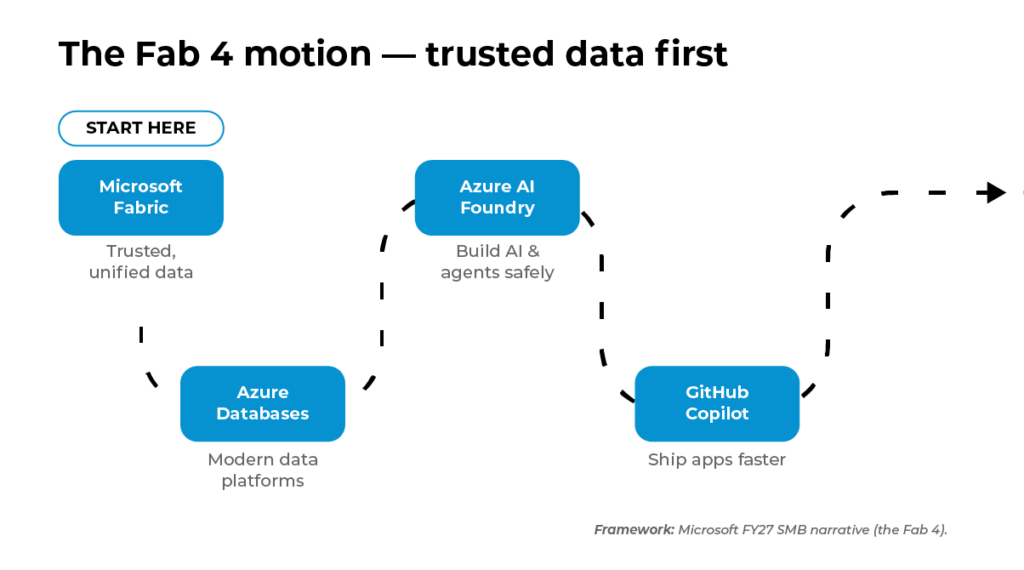
The Fab 4 motion — four connected solution areas, trusted data as the starting point.
The order isn’t accidental: Fabric → Azure Databases → Azure AI Foundry → GitHub Copilot, trusted data first, because that’s what makes every step after it pay off. Read together, the three frameworks say one thing from three angles — the 3C Test is what good data looks like, the Readiness Curve is how mature you are, and the Fab 4 is which solutions get you there, in what order.

The Real Opportunity for Philippine Organizations
The prize is real, and it’s local. Accenture estimates AI could unlock as much as US$79 billion in productive capacity for the Philippines — roughly a fifth of the country’s GDP. The digital economy already generates ₱2.74 trillion in gross value added, close to 10% of GDP, and UNESCAP’s 2026 assessment places the country as an “Emerging Performer” in digital transformation, just below the regional leaders. Demand and raw materials are both here.
The next generation of AI leaders won’t be the organizations that buy the most AI tools. They’ll be the ones that build the strongest data foundations. For banking, financial services and insurance, healthcare, manufacturing, and fast-growing enterprises, most of the needed data already exists—often in abundance. It sits in silos. The work is connecting it, governing it, and making it usable for AI. Fix that, and every downstream AI investment starts delivering a 10× return rather than a 3× return.
Why Tech One Global
Building an AI-ready data foundation isn’t a single technology deployment. It requires data architecture, modernization, governance, analytics, security, cloud capability, and business alignment to move together — which is why the partner guiding the journey matters as much as the platform.
6
Microsoft Solutions Partner designations
11
Microsoft Advanced Specializations
4×
Microsoft Philippines Partner of the Year
The Real AI Question
For most organizations, the question is no longer whether to invest in AI. For most organizations, the question is no longer whether to invest in AI.
The better question
Can our AI trust the data we already have?
Competitive advantage is increasingly set not by access to models — those are shared — but by the quality, accessibility and governance of the data that powers them. The organizations that solve this will be positioned to achieve stronger AI outcomes, and to become the next generation of Frontier Firms. And that journey starts with trusted data.
Source
- MIT Project NANDA, The GenAI Divide: State of AI in Business, 2025.
- RAND Corporation, analysis of enterprise AI initiatives (AI project failure rates).
- Gartner — AI-ready data and data-quality cost research.
- KPMG AI Quarterly Pulse Survey, 2025.
- MuleSoft (Salesforce) Connectivity Benchmark, 2025.
- Philippine Statistics Authority — digital economy and establishment technology use.
- Philippine Institute for Development Studies (PIDS) — AI adoption and readiness, 2024–2026.
- UNESCAP, Asia-Pacific Digital Transformation Report
- Accenture Philippines — AI productive-capacity estimate.
- Microsoft — Microsoft Fabric and OneLake documentation, 2026.
- Microsoft — Work Trend Index (the Frontier Firm), 2025–2026.
- Microsoft — FY27 SMB narrative (the Fab 4).