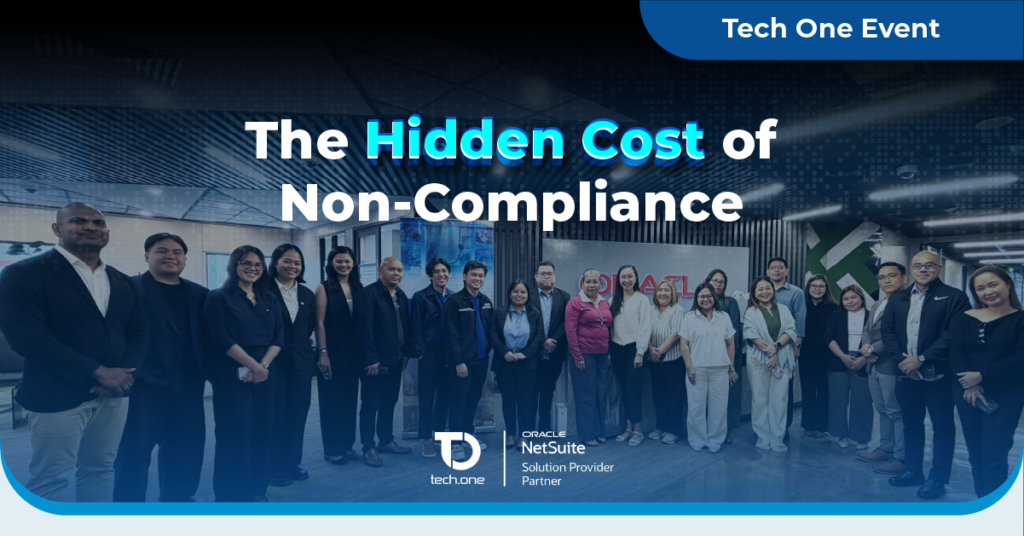
In a regulatory environment that is tightening on multiple fronts, compliance has moved beyond the finance department. It is now a leadership conversation, a business risk question, and a measure of how prepared an organization truly is for what comes next. For Philippine businesses, the question is no longer whether to be compliant, but whether their current systems can sustain the kind of compliance the Bureau of Internal Revenue (BIR) now expects.
This was the foundation of our recent event, The Hidden Cost of Non-Compliance, last June 9, 2026, at the Oracle NetSuite Philippines Office — a closed-door session co-hosted by Tech One Philippines and Oracle NetSuite Philippines that brought together finance and compliance leaders for a closer look at what is changing in the BIR audit landscape and what genuine preparedness looks like in the second half of 2026.
The session was opened by Juan Paolo Co, Sr. Channel Sales Manager at Oracle NetSuite Philippines, who framed why system integrity and accuracy at the source have become non-negotiable for businesses operating in the country today.
A New Era of BIR Audits Has Already Begun
The discussion was led by our guest speaker: Atty. Imee Cobarrubias, CPA, OIC – Head of Legal and Compliance at PCX Markets Philippines, Inc., walked the room through the reforms shaping how the BIR conducts audits today and in the years ahead.
Anchored on recent issuances — including RMC No. 8-2026, RMO No. 1-2026, and RMO No. 6-2026 — the briefing explored how the BIR is shifting toward a more structured, evidence-based audit framework, covering:
- The move toward risk-based and system-assisted audit selection, which removes discretionary selection by examiners
- Higher standards for audit assessments, where deficiency findings must be supported by verified facts and clear legal bases
- Strengthened documentation and audit governance throughout the audit process
- The mandatory and priority audit cases that finance leaders should be most aware of
The session also examined the BIR’s broader digitalization initiatives — the Electronic Invoicing System (EIS) and the Electronic Sales Reporting System (ESRS) — both of which carry significant implications for large taxpayers, businesses under the Large Taxpayers Service, and organizations using computerized accounting systems (CAS). With the e-invoicing deadline just months away on December 31, 2026 under RR No. 11-2025 and RR No. 26-2025, the practical question is no longer if systems should be ready, but how soon. Atty. Imee also grounded the discussion in the actual cost of falling short — from surcharges and interest, to compromise penalties and criminal liability.
Why This Matters Right Now
The urgency cannot be overstated. With less than six months remaining before the e-invoicing mandate takes effect, Philippine businesses are operating in a narrow window where decisions made today shape how prepared and operationally sound an organization will be when the BIR’s enforcement framework fully comes online.
Non-compliance is no longer simply a financial inconvenience. It carries direct consequences for business continuity, reputation, and executive accountability. A single audit finding can trigger penalties that exceed the cost of meaningful system investment, and for organizations still relying on manual processes, the distance between what their systems can defend and what the BIR now expects continues to widen with every passing month.
Sessions like this exist not to alarm, but to create the clarity leadership teams need to move forward with confidence.
The Quiet Risk That Most Businesses Still Carry
A consistent thread throughout the morning was this: in a tightening regulatory environment, the organizations most at risk are not the ones without processes. They are the ones whose processes still depend on manual reconstruction.
Manual withholding tax computation, Excel-based BIR Relief filings, disconnected books of accounts, and reactive documentation are no longer sustainable when the BIR is actively moving toward system-assisted enforcement — setting the stage for the demonstration that followed.
When Compliance Is Built Into the System, Not Around It
The live demonstration was led by Angelou Poblete, Functional Consultant – Oracle NetSuite at Tech One Philippines, who showed how Oracle NetSuite delivers full BIR coverage end to end — not as a workaround, but as how the system operates natively across five interconnected areas:
- Tax and Expanded Withholding Tax (EWT) — applied automatically at the point of transaction, tied to the correct BIR ATC codes, with vendor rates set once and enforced consistently
- BIR-formatted commercial documents — Sales Invoice, Collection Receipt, and Credit Memo, generated directly from the system in compliant format
- The six BIR-required Books of Accounts — available on demand and pulled from the same live transaction data that drives the financial statements
- Quarterly BIR Relief and alphalist reporting — turned from a days-long manual exercise into a structured export
- Audit-readiness built in — through a full system log on every transaction, posting controls, and role-based access that enforces internal controls at the system level
The takeaway was clear: compliance is not a workflow layered onto the business. It is something the system either supports natively, or it does not.
Readiness Is a Posture, Not a Project
This thread carried into the reflection from Carlo James G. Dela Cruz, Sales Manager for Small & Medium Enterprises at Tech One Philippines, who spoke on what genuine preparedness looks like in practice — not as a one-time project, but as a sustained operational commitment.
The path forward is rarely about replacing everything at once. It is about building a foundation where accuracy at the source, system-enforced controls, and audit-readiness become part of how the business operates every day.
Attendees engaged actively throughout the morning, raising practical questions on audit triggers, documentation standards, and the operational shifts required to meet the December 2026 deadline.
Where the Conversation Goes From Here
The session was brought to a close by Lahiru Munindradasa, Chief Technology Officer (CTO) at Tech One Global, who underscored why this discussion matters now more than ever. In his closing remarks, he reflected on the responsibility that comes with operating in an environment where compliance, technology, and leadership intersect more closely than before — and reminded the room that the businesses best positioned for what lies ahead are those willing to engage early, partner intentionally, and treat preparation as a strategic priority rather than a regulatory checkbox.
As the 2024 Oracle NetSuite Rising Star Awardee in the Philippines, Tech One Philippines continues to support clients as a long-term partner in navigating the BIR’s evolving requirements.
We appreciate Oracle NetSuite Philippines for the meaningful collaboration, and we thank everyone who joined us for the honest exchanges that shaped the morning. Compliance is no longer a back-office concern. It is a leadership decision — and the businesses acting now, with the December 2026 deadline in clear view, are the ones shaping their own path forward.
If your organization is mapping out its compliance readiness ahead of the deadline, our team at Tech One Philippines would be glad to start the conversation with you.
📧 contact@techoneglobal.com 📞 +63 2 8782 4968